

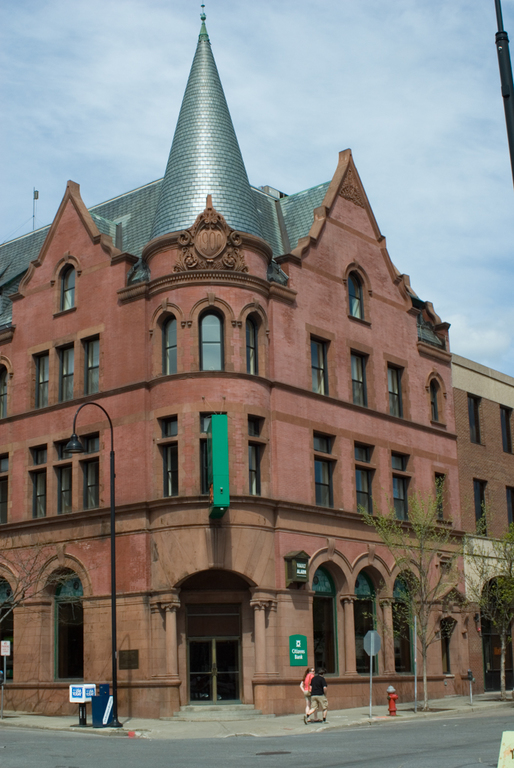
Charles P. Smith commissioned the architect of his recently completed brick and stone mansion (225 S. Willard Street) to design a replacement for Ammi B. Young's former Bank of the United States (1830). Willcox created a distinctive edifice as the corner piece to the bank row overlooking City Hall Park: Burlington Trust Company (1891, Clellan Fisher) and Merchants Bank (1895, Sydney Green) at 162 and 164 College Street, respectively. With its steep, dormered roof and shaped Flemish gables it recalls the guildhalls and banking houses of Renaissance Antwerp and Brussels by way of Richard Norman Shaw's late-nineteenth-century London. Using a muted brick and sandstone palette, Willcox elaborated on a vocabulary he had used for the modest buff brick building at 135 College Street that housed his own office between 1899 and 1907. He created great richness through rhythms of clustered windows, Ionic arcades, scrolled keystones, dentil courses, terra-cotta panels, and a splendid cartouche on the corner tower announcing the main entrance. The interior retains its original horseshoe-shaped central counting room (the last surviving one in Vermont) in a setting of brass, green marble, and elaborate wood carving by Albert Whittekind.
Charter One Bank (Burlington Savings Bank)
1900, W. R. B. Willcox. 148 College St., City of Burlington