

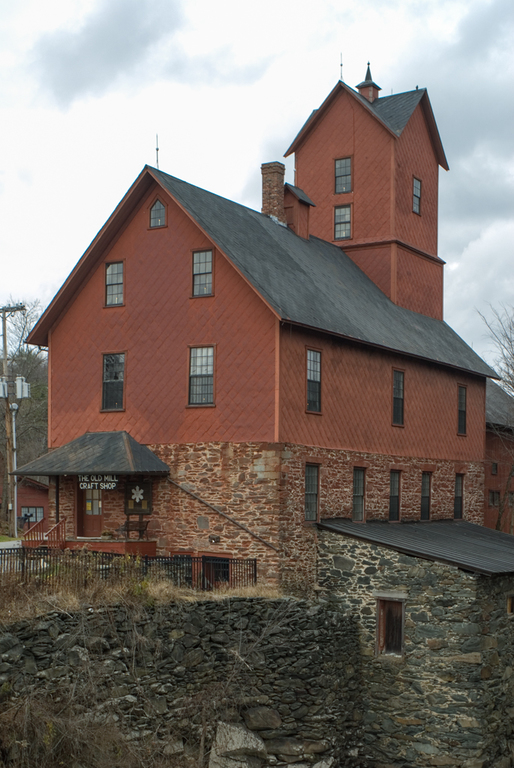
Jericho's “Old Red Mill,” a local landmark dramatically sited at a steep drop in Brown's River, is a late-nineteenth-century chapter in the story of local grain and feed processing, a once-common industry now vanished from the Vermont landscape. James Hutchinson purchased an old starch mill on this site in 1855, and in 1856 built a gristmill here. In 1859 he constructed the small Gothic Revival house that stands nearby. L. B. Howe and F. Beach purchased the mill in the 1860s and in 1885 rebuilt the mill in its present form with a stone wheelhouse in the river, a stone first story, stamped tin on the second story and on the half story, and a cross-gabled elevator tower. A two-story grain storage ell, part of the original mill, was connected to the new mill below the tower at one gable end. “Roller Process” milling machinery was installed, and more than twenty tons of machinists' work—including waterwheels, shafting, pulleys, and gears—was done by the Edward Stevens iron foundry in Winooski. Of heavy timber-frame construction, the 1885 mill's walls are of stacked 2
×
6–inch spruce planks, banded with iron. It is probably the largest structure in Vermont making use of this stacked-wall technique more commonly found in houses and silos and popular at the turn of the nineteenth century when the forests of the Green Mountains were harvested. The mill was named Chittenden Roller Mills and they shipped flour throughout New England until competition from western mills led to its closing in 1904. It is now owned by the Jericho Historical Society.
Jericho Historical Society (Chittenden Roller Mills)
1856–1885. 4 Red Mill Dr., Jericho village