

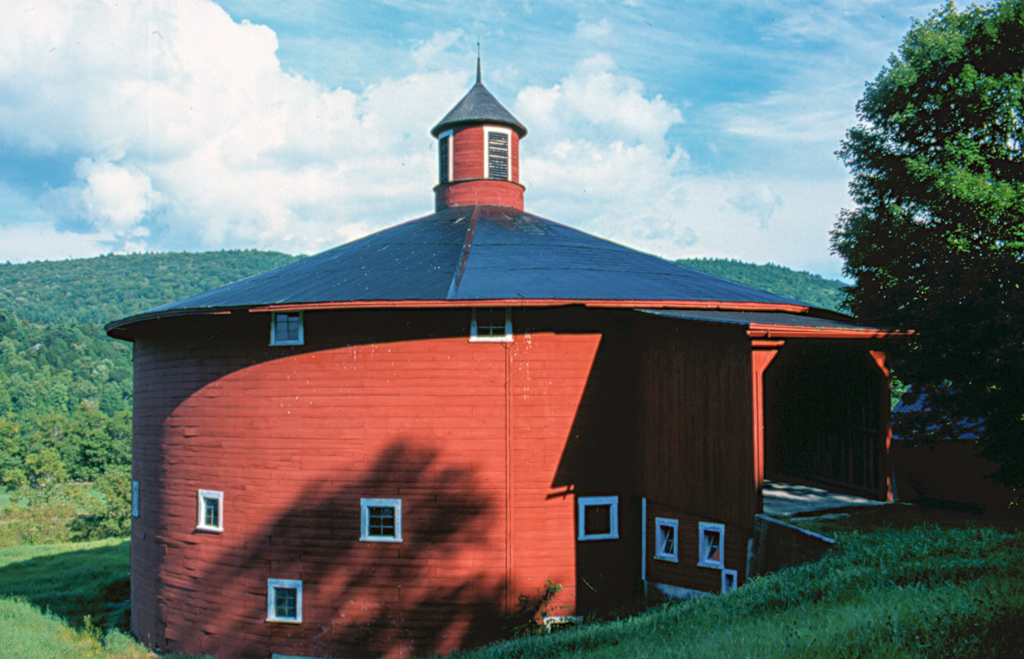
Fred Quimby of the East Barnet contracting firm of Quimby and Galbraith was likely involved with James Moore's then-novel decision to build a round barn. Quimby is usually credited with this early example of the round silo barn form as well as many others built after it in Caledonia County and neighboring New Hampshire. It is certain that Quimby and/or Moore were acquainted with the design for a round barn built around a silo promoted by Franklin H. King of the Wisconsin Agricultural Experiment Station in a number of publications during the 1890s, such as Hoard's Dairyman (1895) and the Breeder's Gazette (1897). This true round barn was constructed several years before enterprising midwesterners tried to patent the “cyclone-proof” round barn designs. The small size of the barn (about fifty feet in diameter) and its prominent location on the main river road may indicate that it was something of a demonstration model for Quimby, who advertised that he built it for less than two thousand dollars in labor and materials, low cost being one of the supposed advantages of round barn designs. Regardless, it is a northern New England bank barn for about twenty cows, with a ground story for manure storage, stables on the second, and a third-floor haymow accessed by a covered bridge. Throughout the surrounding area, Quimby and Galbraith erected one round barn a year for the next decade, possibly adding a lower-cost polygonal form to their repertoire after they built one designed by St. Johnsbury architect Lambert Packard in 1903 on Hastings Road in Waterford.
Moore Round Barn
1899, Fred Quimby. U.S. 5 at Joe's Brook Rd.