

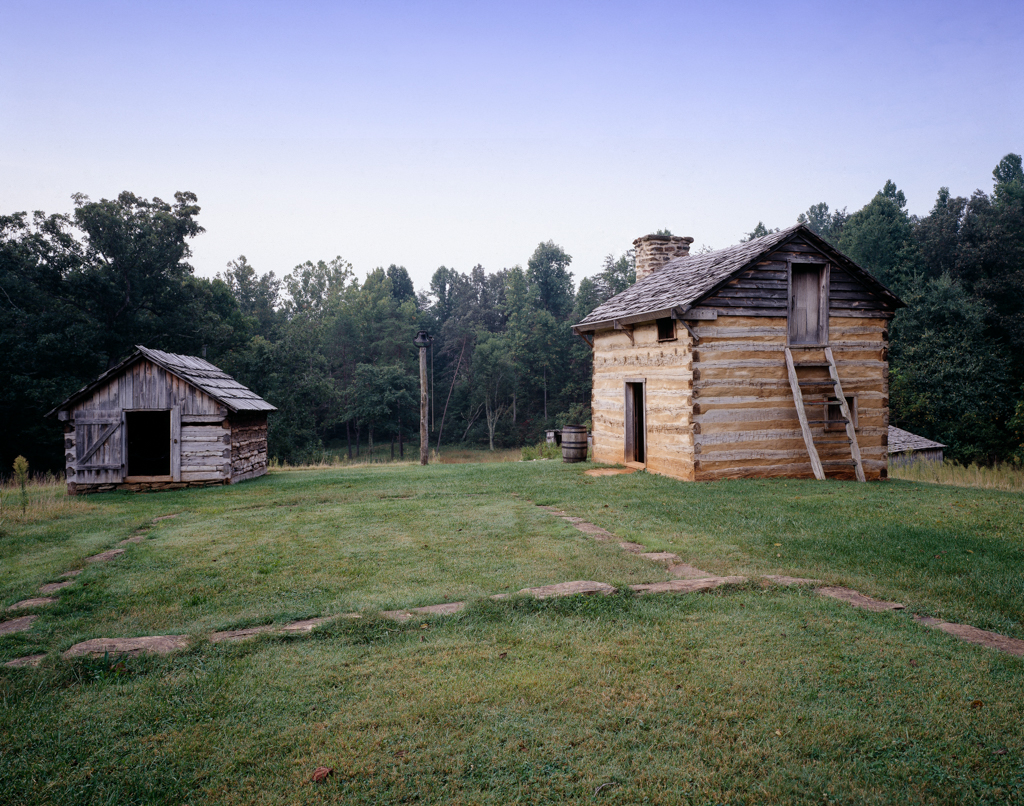
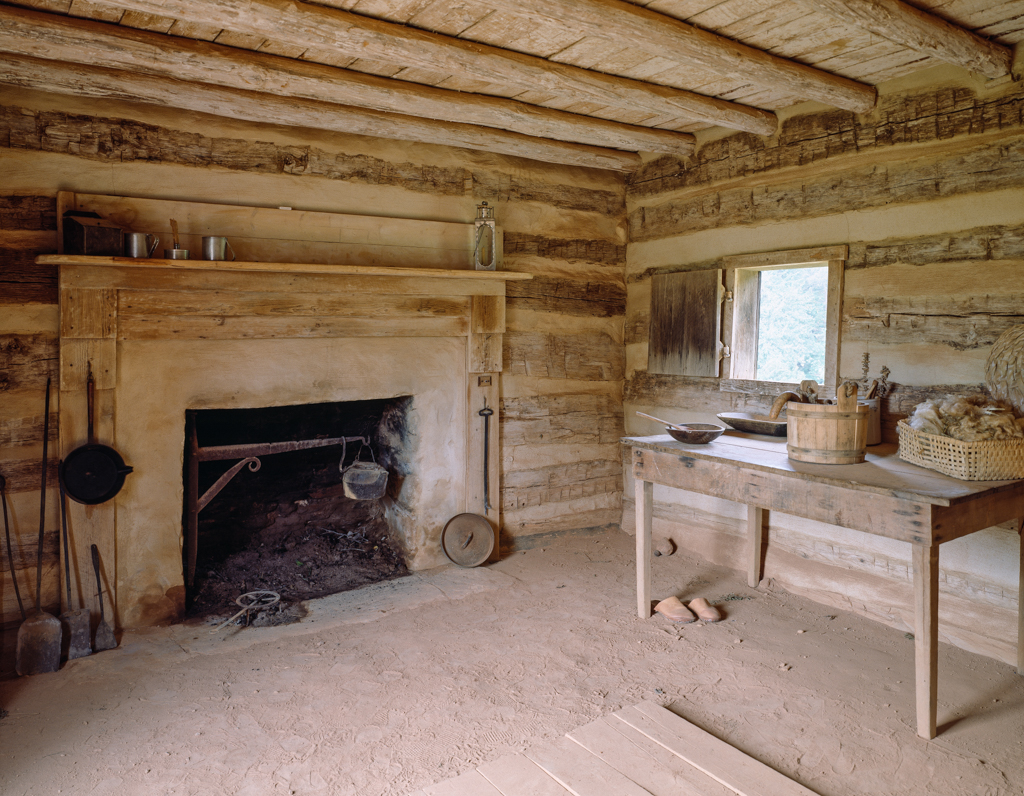
Booker T. Washington was born into slavery in 1856 in a log cabin on the tobacco plantation of James and Elizabeth Burroughs. In his autobiography, Up from Slavery (1901), Washington recounts the story of his hardscrabble childhood and evolution into a major educational and cultural figure of his time. The pragmatic Washington not only established in 1881 a school for African Americans in Alabama that became Tuskegee Institute but also helped lead America's blacks and whites to a better understanding of each other. A replica of the one-room cabin where he lived as a child has been constructed along with other outbuildings and a center for interpreting this history. In his autobiography, Washington wrote of his childhood home, “The cabin was not only our living-place, but was also used as the kitchen for the plantation. . . . The cabin was without glass windows; it had only openings in the side which let the light in, and also the cold, chilly air of winter. There was a door to the cabin—that is, something that was called a door—but the uncertain hinges by which it was hung, and the large cracks in it, to say nothing of the fact that it was too small, made the room a very uncomfortable one . . . we slept in and on a bundle of filthy rags laid upon the dirt floor.”
Booker T. Washington National Monument
Mid-19th century; later additions. 12130 Booker T. Washington Hwy.