

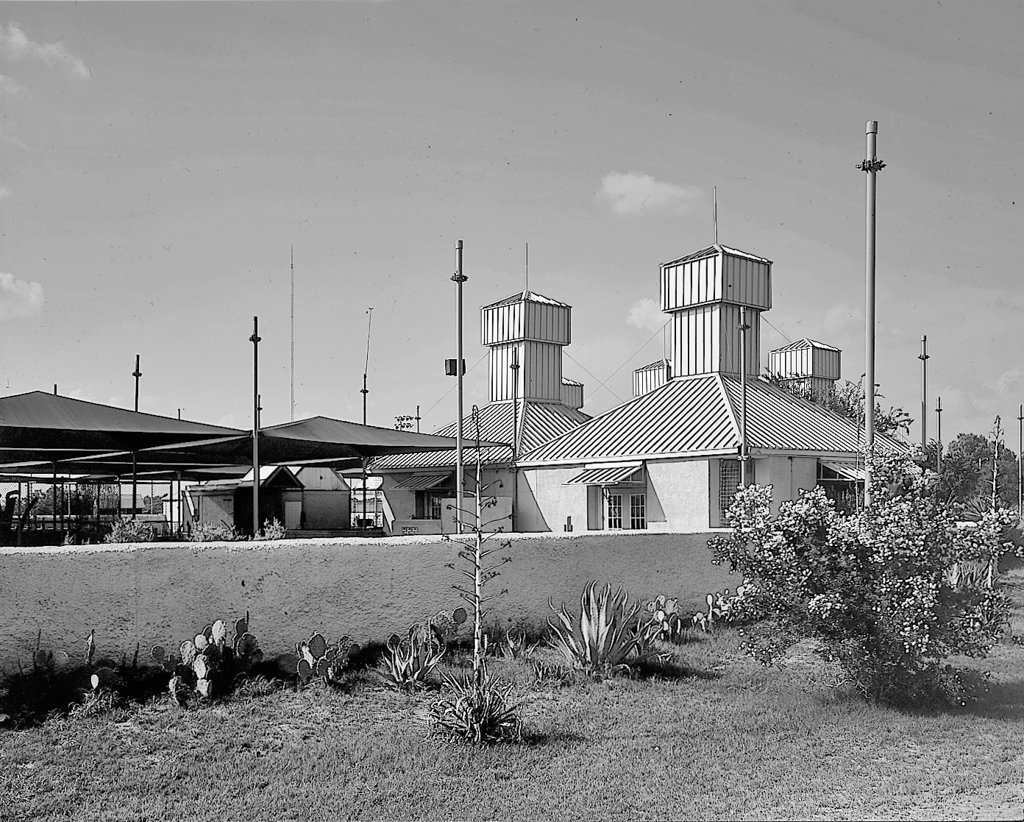
The main attraction of the fort may well be the former experimental farm project. Located near the Rio Grande, the set of buildings and agricultural fields were originally intended to serve as examples of sustainable development, economically and ecologically, in a region of high population growth with limited resources.
Composed of five cubic sheds, the units were built of stacked bales of hay covered with sprayed concrete and topped by pyramidal roofs culminating in evaporative cooling towers. In the courtyard created by the clustered units, cisterns collected roof water, much in the same manner found historically in the region where scarce water was stored in underground, dome-shaped, stone-lined aljibes, or wells.
Extending beyond the sheds, a grid of twenty-four-foot-high steel pipe columns held polyester canopies to shade experimental crops from the intense summer heat. To irrigate the fields, water was drawn from the Rio Grande by pumps powered by four wind turbines. Abandoned within a year of its promising inauguration due to conflicting local and external agendas, the rehabilitated facility, now with air-conditioned interiors, serves as a science facility for Laredo Community College.
North of the former demonstration farm, a dirt road—rebuilt by the Works Progress Administration (WPA) in the 1930s—leads to the original star-shaped earthen fort set above a fifty-foot bluff overlooking the Rio Grande.