

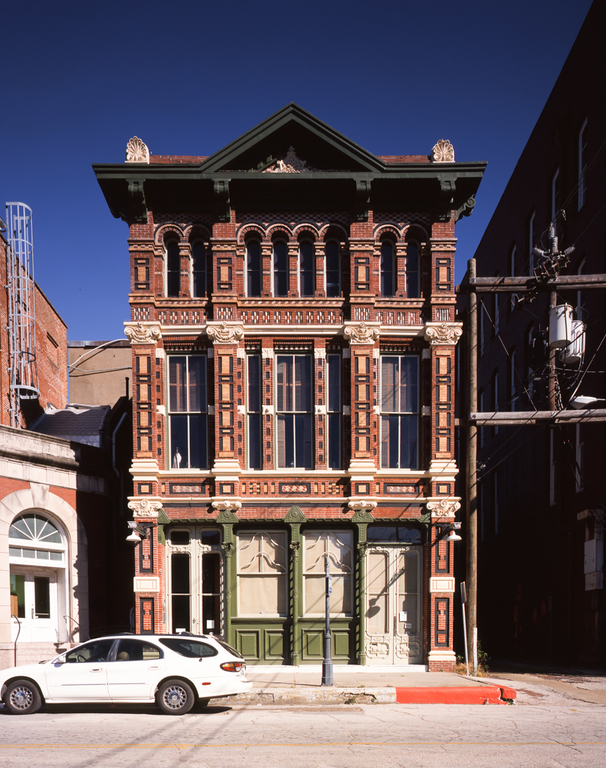
The three-story building housed the offices of a successful broker of Texas ranch and farm real estate. On its compressed street front, sandwiched between bigger buildings at this side-street location, Clayton compacted a tripartite frame consisting of a rising central bay flanked by narrow side bays. He enriched this frame with brick panels of different color and different degrees of projection, using limestone and cast iron to punctuate the frame. Clayton essayed decorative exuberance with an economy that makes the exuberance all the more effective. Looming over the Trueheart Building is the four-story former Kauffman and Runge Building of 1882 by Eugene T. Heiner at 220 22nd Street.
Visible from the sidewalk in front of the Trueheart Building are the headquarters of Galveston's major twentieth-century financial institutions. The ten-story Bank of America of 1972 (formerly First Hutchings Sealy National Bank) by Caudill Rowlett Scott occupies a full-block site at 2200 Market Street. Opposite at number 2201, and exhibiting a much more urbane demeanor, is the eleven-story Frost National Bank Building (formerly United States National Bank) of 1925 by New York City architect Alfred C. Bossom. At 2219 Market Street, the Galveston County Historical Museum (formerly City National Bank) of 1920 is a terra-cotta-faced Roman temple by Chicago architects Weary and Alford.