

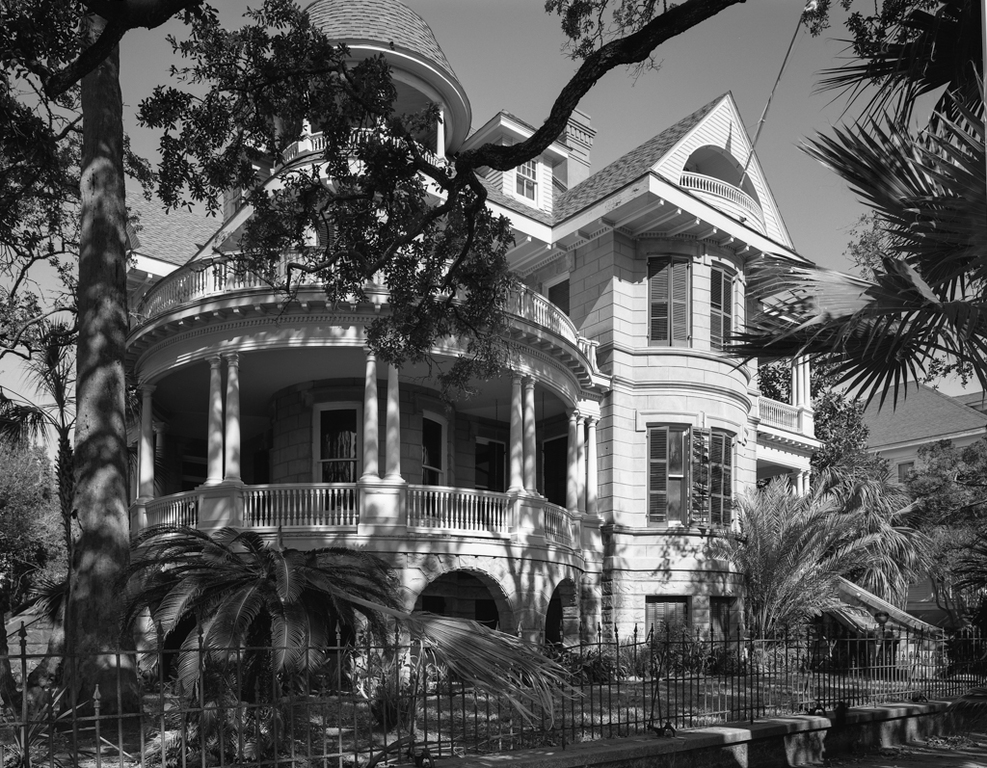
By virtue of its size and stucco-faced brick construction, the Clarke House might well have sat on Broadway, one block south of Sealy Avenue. The Clarke House's survival attests to the long-term wisdom of not building on a major traffic artery as well as another factor crucial to the survival of Galveston's nineteenth-century residential stock: the conservatism—and longevity—of their owners. Three generations of the Jockusch family, descendants of a Prussian immigrant who came to Galveston via Havana in 1843, have occupied the house since 1928. Stowe, the architect, was one of a number of Galveston-born architects who began practice in the mid- and late 1890s. He was influenced by the restraint of McKim, Mead and White's Sealy House, “The Open Gates” (
GV17), although he managed to incorporate an array of buoyant circular shapes, including a high-raised cylindrical piazza carried on rusticated arches, framed with paired classical colonnettes, and oriented to the Sealy Avenue–18th Street corner.
Charles Clarke House
1900, George B. Stowe. 1728 Sealy Ave.