

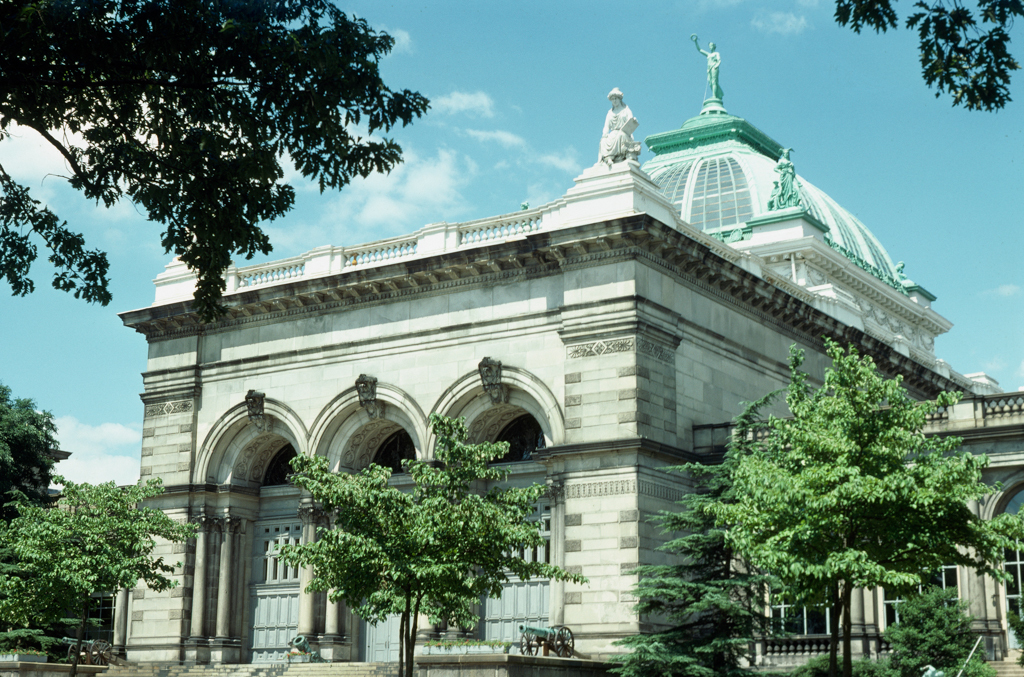
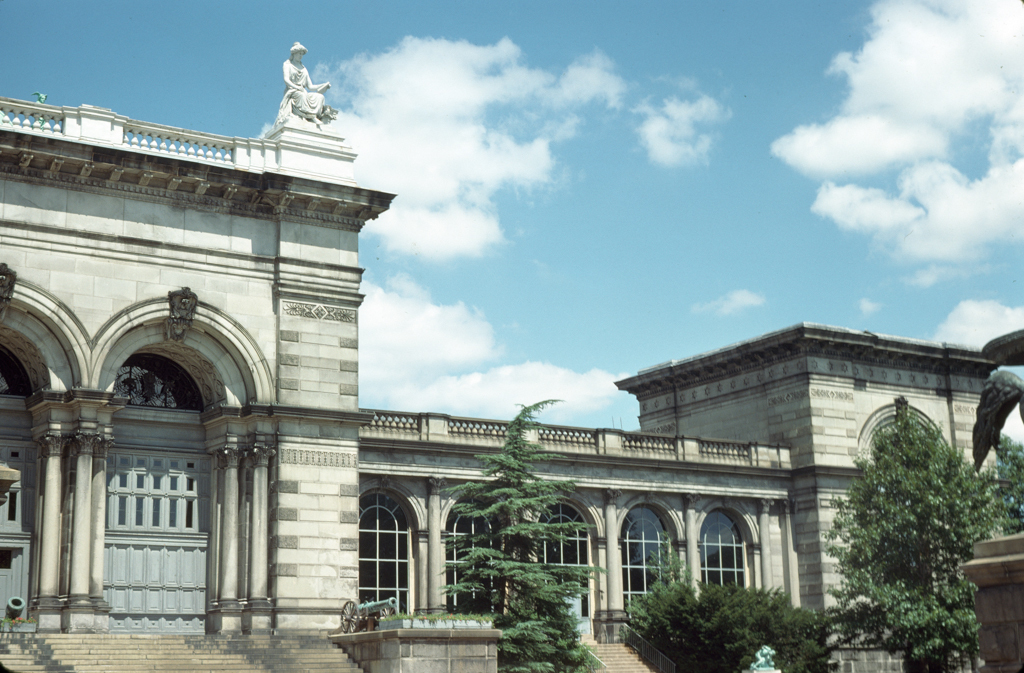
Memorial Hall was envisioned from the first as the permanent memorial of the 1876 Centennial Exhibition, which was held here in what today is West Fairmount Park. The immense Main Exhibition Building and Machinery Hall, both designed by Henry Petit and Joseph Wilson, were intended to be temporary structures, and although they were more progressive in their mass-produced
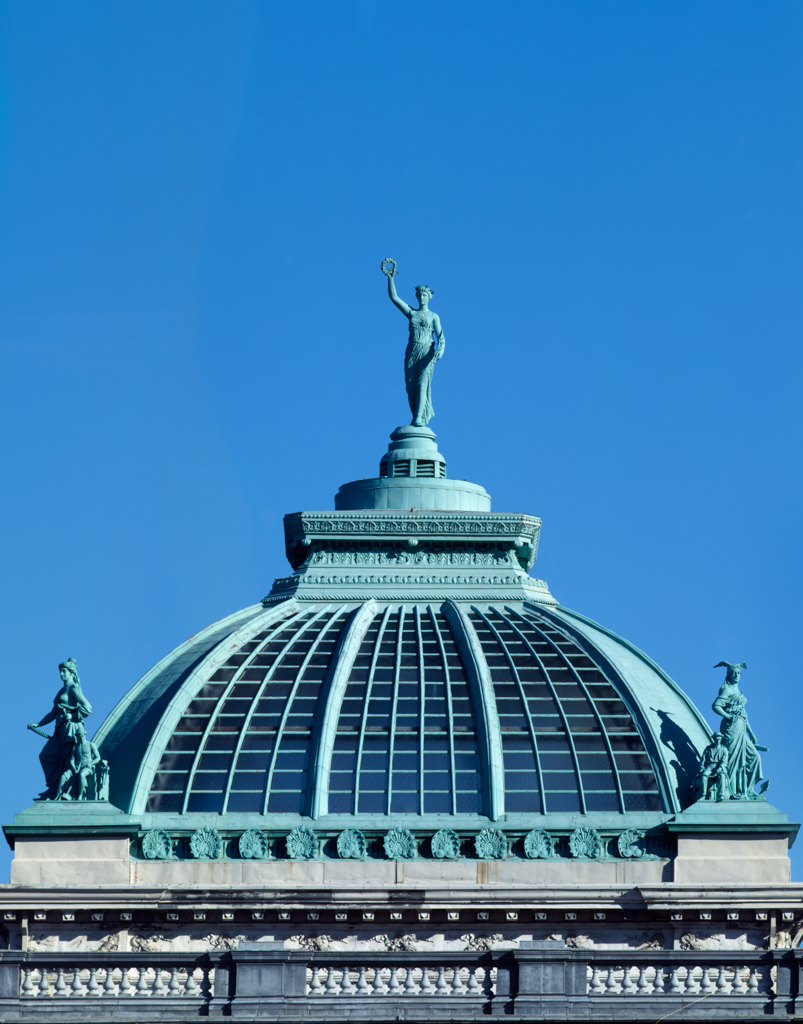
PH129) landscape architect, Munich-born Schwarzmann, to design Memorial Hall, lay out the grounds of the fair, and design many of its secondary buildings. Thus the American centennial, ironically, was marked by a building of decidedly Germanic character, close in spirit to the contemporary designs for the new German Reichstag, known from its well-published competition. At the apex of Schwarzmann's building is its most American gesture, a four-sided glazed dome surmounted by a figure of Columbia, surrounded by subsidiary figures of Industry, Commerce, Agriculture, and Mining, representing the labors of the Civil War era.
After the fair, Memorial Hall was adapted to serve as the city's museum of art, retaining that role until its replacement in the 1920s by the present museum on the Benjamin Franklin Parkway (
PH123). Adapted in the 1970s by Hatfield, Martin and White to serve a variety of uses including a swimming pool and Fairmount Park Police offices, it has since been adapted as the home of the Please Touch Museum, a center for children's interests in concert with the nearby zoo. At 4021 Parkside Avenue is Philadelphia's School of the Future, built in collaboration with Microsoft and designed by the New Jersey firm Prisco Group (2004–2006).