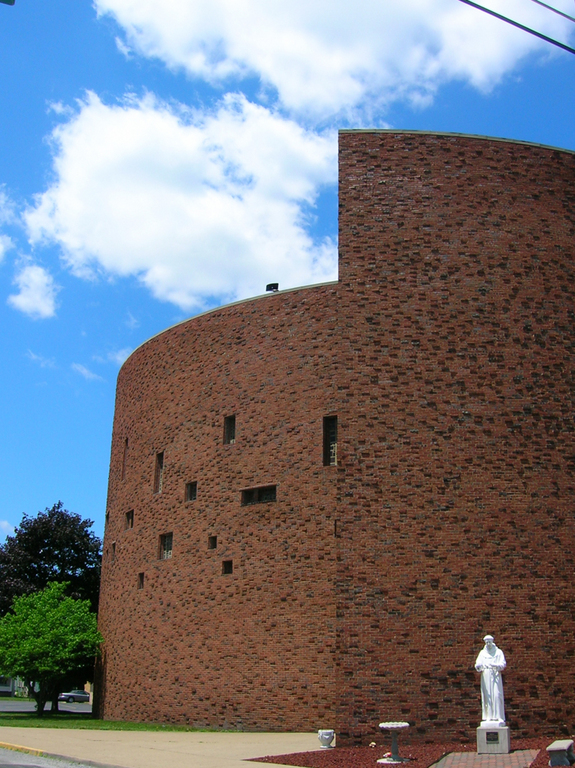
St. Vitus is the patron saint of Baia Latina, Italy, the original home of many of the Italian immigrants to New Castle. One of the few ethnic parishes in the region, the congregation of St. Vitus serves parishioners almost entirely of Italian heritage within a five-mile radius. The church, of poured reinforced concrete and faced with a locally produced brick, is designed without interior supports to create a sense of oneness between the altar and the congregation. It has a rounded shape with three entrances fanned along the wall opposite the altar that approximates the shape of a nautilus or of a sheaf of paper gently rolled. While the church seats nearly 1,000 people, it does not give the impression of overwhelming vastness, as do other churches of similar size. Architect P. Arthur D'Orazio, a 1934 Carnegie Institute of Technology graduate, had a forty-five-year solo architectural practice based in Youngstown. He designed over twenty-five buildings in western Pennsylvania, including four churches in Lawrence County: St. Vitus, the former St. Anthony's (1958–1959; PA 317, Bessemer); the former St. Michael's (1967; 1701 Moravia Street, New Castle); and the former Purification of the Blessed Virgin Mary (1968–1970; 415 4th Street, Ellwood City).
A small circular baptistery connects to the main structure by a narrow passage faced with panels of white chipped marble; an open metal bell tower with three hanging bronze bells rests atop it. The interior is finished with a rich palette of materials, including generous amounts of marble, glass mosaic, bronze, and aluminum. Many artisans, both local and Italian, supplied the ornament for this unique church. Above the main altar, a 42 × 20–foot Venetian glass mosaic illustrates Christ triumphing over Satan, surrounded by studies of important events of Christ's life. Other murals in the church represent the Holy Trinity. Windows made of heavy chipped glass designed in abstract patterns by the Hunt Studios of Pittsburgh allow colored light to flood the interior through variously sized openings. The bas-relief on the marble main altar, the side altars, and the baptismal font were designed by sculptor Pero Aldo.