

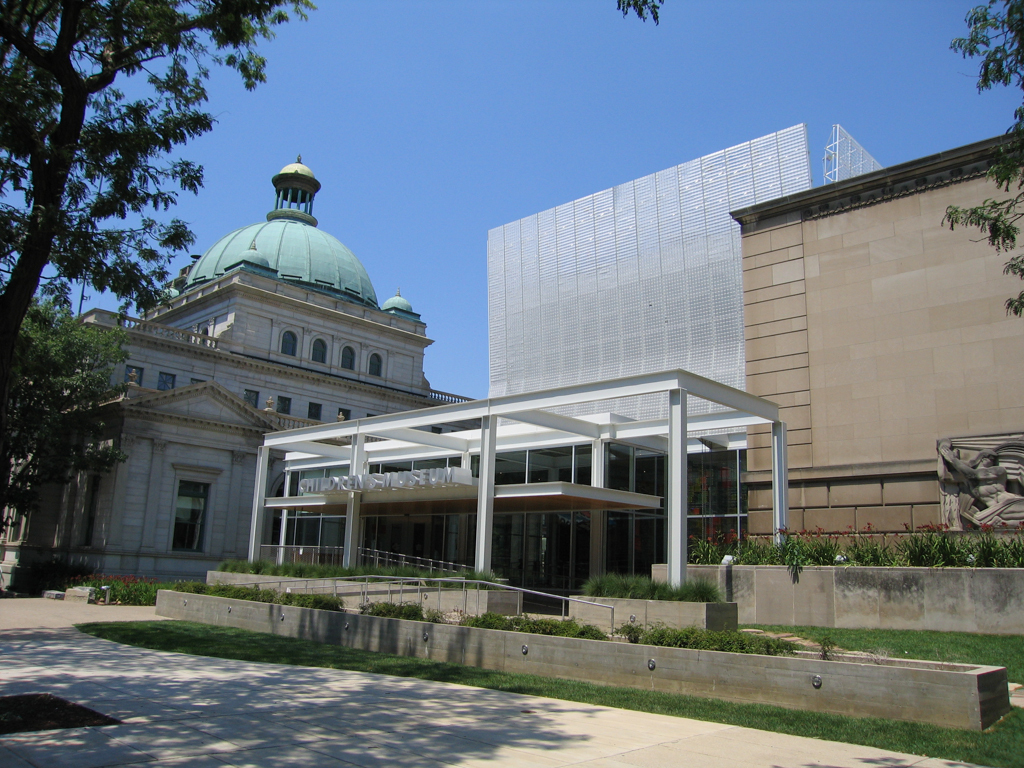
When Buhl Planetarium opened in 1939, it was the largest of the five planetaria in the United
The Buhl's science exhibits, rooftop observatory, and astronomy workshops, as well as it planetarium, drew many visitors. Supplanted in 1991 by the Carnegie Science Center (AL68), the Buhl was given to the Children's Museum, which in the previous decade had taken over the Renaissance Revival Allegheny City Post Office (1894–1897, William Aiken).
The Buhl's exterior stripped classical walls, clad in gray limestone, hint at streamlining in their stylized quoins, and bold astronomy-themed Art Deco reliefs by Sidney Waugh provide a foretaste of the stylishly decorated interior. In 2004, an addition linked the Buhl to its neighbor, the former post office, to give convenient access between the two parts of the museum. The glass addition is sheltered by a gossamer-like screen of plastic petals that ruffles in the wind, yet allows light to enter the newly created space. A wind sculpture by Ned Kahn stands in the forecourt. Inside the museum is a replica of Mr. Rogers's Neighborhood House and puppets from his famous children's television show filmed locally at WQED (AL119).