

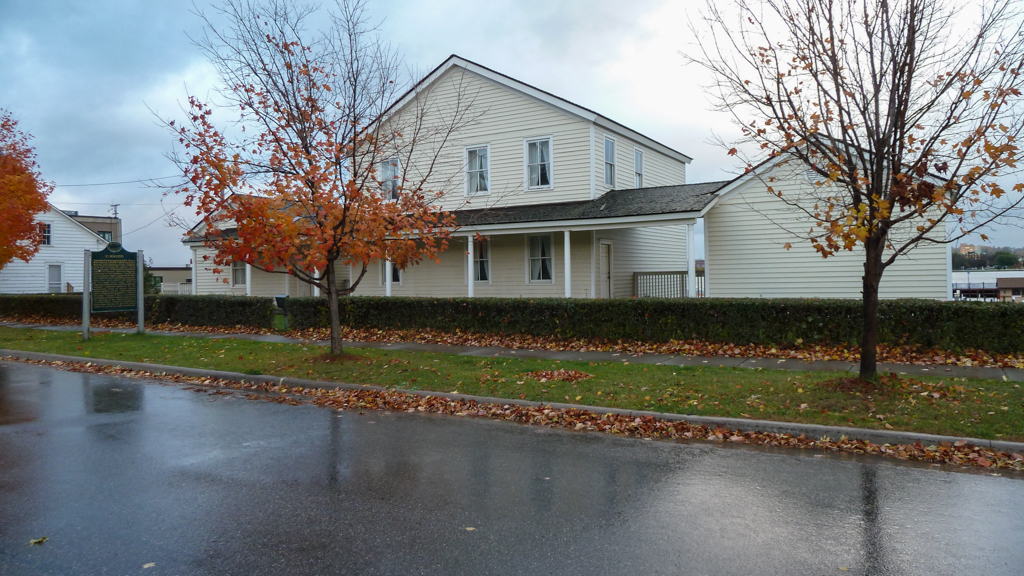
Elmwood was built for Henry Rowe Schoolcraft (1793–1864), noted explorer, ethnologist, geologist, and Indian agent, in the Federal style by Wait, builder of the old territorial capitol and courthouse in Detroit in 1828. The house was drastically transformed into a Queen Anne building in the late 1880s, when the gables, bays, dormers, shingles, and spindlework were added.
After accompanying Lewis Cass in 1820 on his scientific expedition through the Great Lakes to determine the extent of mineral resources and to promote settlement, Schoolcraft returned to Sault Ste. Marie, where he was appointed U.S. Indian agent. Elmwood served as the agent's house and office, a dormitory for Indians visiting on official business, and a storehouse. Elmwood was a focal point for Indian affairs in the entire Upper Great Lakes and a social center for the people of Sault Ste. Marie and Fort Brady. The Indian Agency was removed to Mackinac Island in 1833, and Elmwood lost its luster and status. Among those who later lived at Elmwood was Charles T. Harvey in the 1850s, who supervised the construction of the St. Mary's Falls Canal. Harvey called the house the only mansion of any pretense west of Mackinac.
Elmwood was used for offices during the early part of the twentieth century. The Michigan Lake Superior Power Company acquired it, and Elmwood was transferred eventually to the Chippewa County Historical Society. In the 1970s, the society moved the house to its present location two blocks upstream from where it had stood for 150 years. It was stabilized in 1986–1987, and, under the auspices of the historical society, Sault Historic Sites, and the city, it reopened as a museum.