

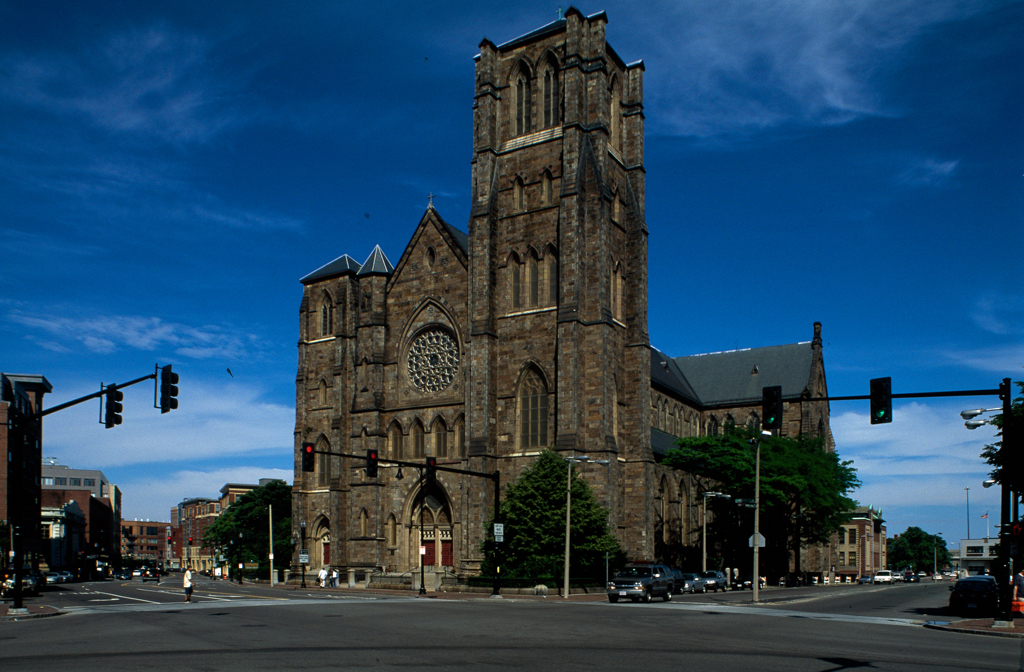
In 1859 Bishop John Fitzpatrick acquired the marshland site for the new Roman Catholic cathedral, the congregation's fifth location. Brooklyn architect Patrick C. Keely submitted plans in 1861 for the first of his New England cathedrals. The Gothic Revival cathedral was dedicated in 1875, on the occasion of the elevation of the Boston diocese to an archdiocese serving New England.
The cruciform building of Roxbury puddingstone trimmed with Quincy granite and sandstone, with a seating capacity of 3,500, was meant to rival European cathedrals. The dimensions are 364 feet in length and 170 feet in width at the transept. The nave is 90 feet wide; its height to the ridgepole is 120 feet. Keely designed the magnificent altar and organ case for the Hook & Hastings instrument, the largest in the United States at that time. Cast-iron pillars support the stone clerestory, allowing for thinner columns that contribute to the lightness of the interior. The ceiling and tracery are carved of three shades of oak; an immense inlaid wood cross adorns the transept ceiling.
The Cathedral of the Holy Cross contains the region's largest collection of stained glass.