

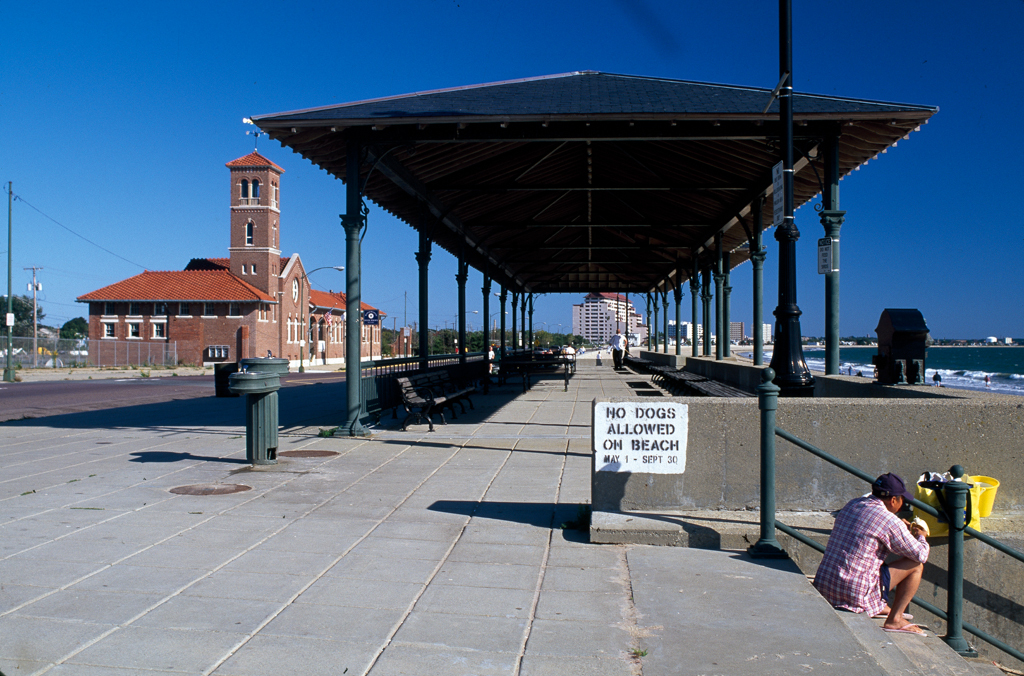
Revere Beach is the first ocean-bathing recreational area acquired by the public sector in the United States and one of the most dramatic accomplishments of the newly established Metropolitan Park Commission. Charles Eliot, the consulting landscape architect for the commission, recommended the acquisition of the property in 1893 and oversaw the development of the beach between 1895 and his death in 1897. With an initial $1,000,000 appropriation from the legislature, the commission removed a railroad from the crest of the beach, eliminated shoddy private amusement facilities, and constructed eight bathing pavilions (1895 and 1905), a bandstand (1895), a bathhouse (1898, now demolished), police station (1899), and superintendent's house (1905), all to the designs of William Stickney. The restored bathing pavilions and bandstand are cast-iron structures set at the crest of the beach. Across Revere Beach Boulevard at the center of the reservation stands the Police Station, a red brick tile-roofed building with a campanile-like tower from which to survey the beach. The immense popularity of Revere Beach lead to the construction of hotels and amusement parks on the land side of the reservation. Although those buildings have been replaced by private houses and apartment buildings, the beach still attracts large crowds on summer weekends to enjoy the uninterrupted stretch of ocean beach that Eliot fought to reclaim.
Revere Beach Reservation
 Peter Vanderwarker or Antonina Smith
With Police Station
1895–1905, Olmsted, Olmsted and Eliot, landscape architects; Stickney and Austin, architects. Revere Beach Blvd.