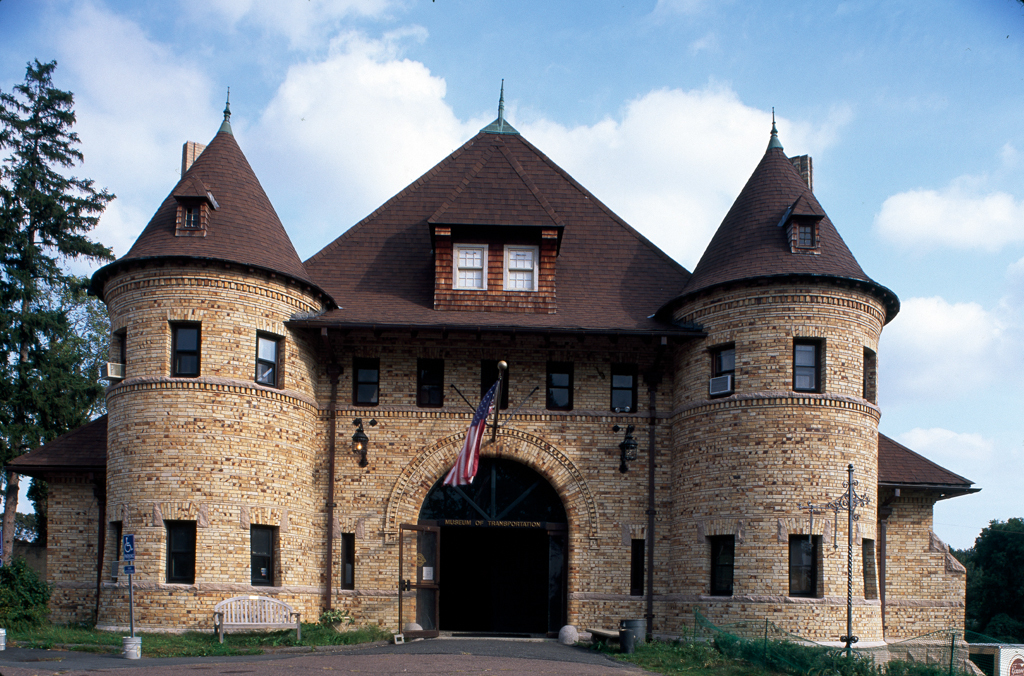
Beginning in 1899, Larz and Isabel Anderson enlarged a property begun by William F. Weld II in 1881 into one of the major country estates in the Boston area. The mansion (originally designed by Edmund March Wheelwright and remodeled by Little and Browne) was destroyed after the property was left to the town for a park in 1948. Wheelwright designed the surviving Weld carriage barn (1889), a magnificent buff brick confection with circular towers and massive roof with multiple dormers, the grandest ever erected in Brookline and now the home of the Museum of Transportation. The handsome wooden interior includes a second-floor gallery overlooking the ground-level area now used to exhibit the museum's collection. The Widow Harris House, a late-eighteenth-century clap-boarded gambrel-roof structure with a saltbox wing of around 1800, stands at the entrance to the park. Opposite the carriage barn is the oneroom Putterham School, built around 1770, enlarged in the 1840s and moved to this site for a museum in 1966.
Among the surviving landscape features, Little and Browne designed the lagoon and temple (1910) when they were remodeling the Anderson mansion. Charles A. Platt added an influential Italian garden in 1901–1902, largely destroyed for an ice skating rink by the Town of Brookline in 1955. A parking lot on top of the hill marks the site of the mansion. Fox and Gale planned much of the minor landscape work, including the poured concrete walls, and the gardener's house at 29 Avon Street.