

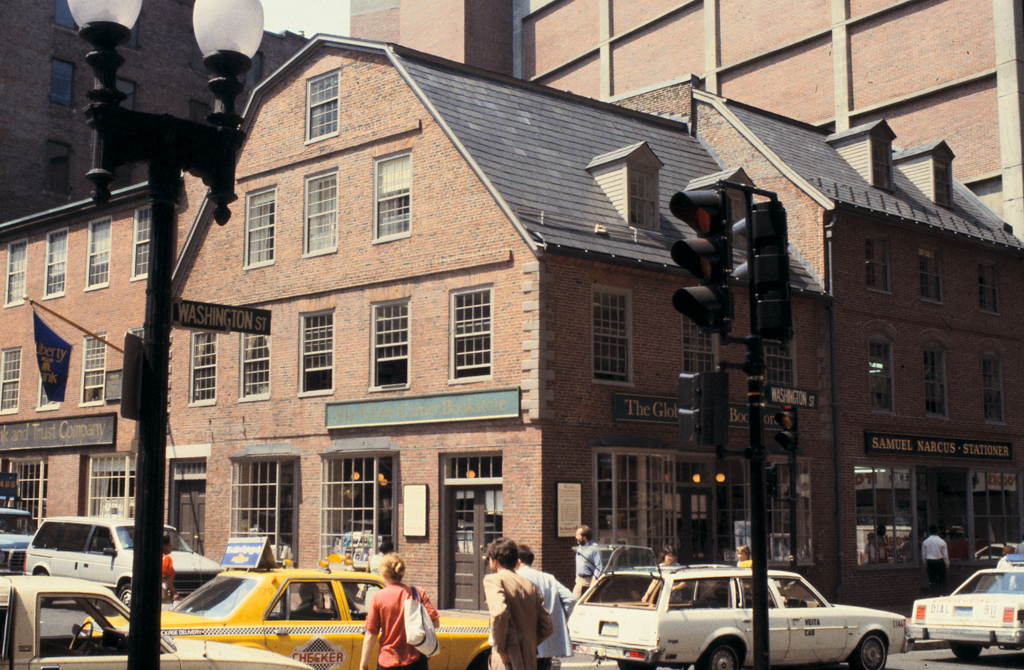
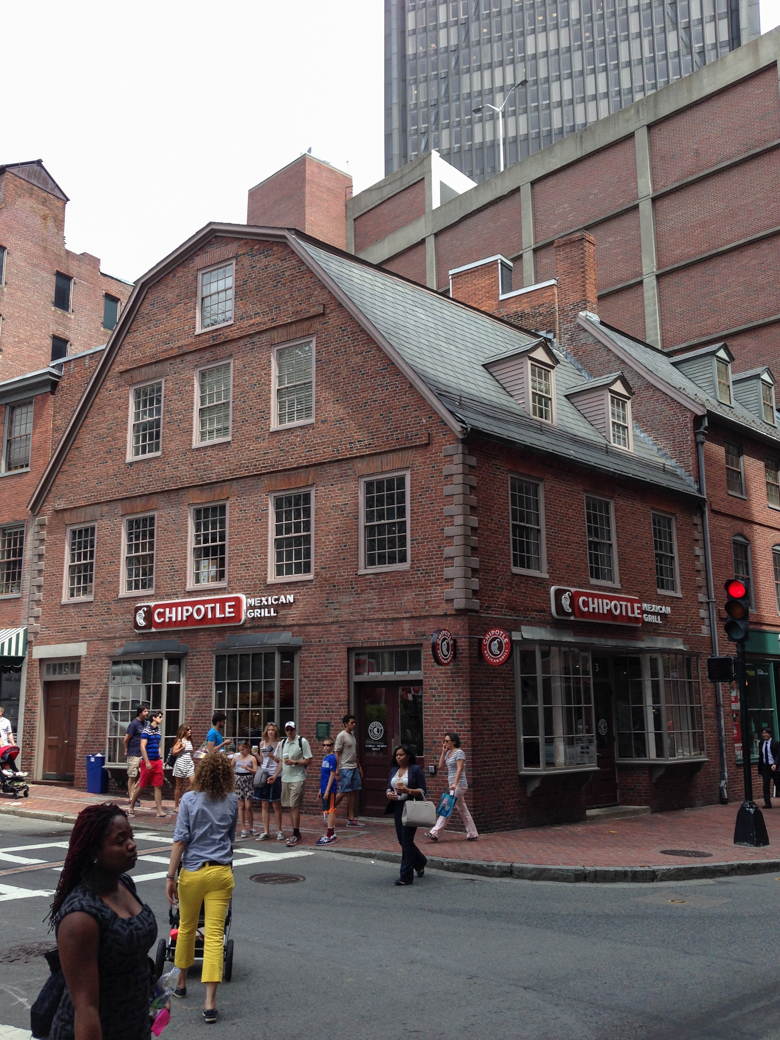
The Boston fire of 1711 led to changes in building laws that proscribed wooden construction in the center of town, as seen in these remarkable brick Colonial survivors at the corner of Washington and School streets. Thomas Creese erected the gambrel-roofed building long known as the Old Corner Bookstore for his residence and apothecary shop. Next door on Washington Street, Andrew Cunningham Jr., a glazier, constructed his house and shop in about 1728. Major changes to both buildings occurred in about 1828 when the wooden ell on the rear of the corner house was removed and replaced with a row of two-story buildings (5–11 School Street). During this period, the first-story facades of both eighteenth-century structures were altered to accommodate shop fronts.
The Old Corner Bookstore is of major significance in the history of American publishing. As early as 1796, a bookseller was located in the corner building. Carter and Hendee, booksellers and publishers, constructed the blocks on School Street. Most important, Ticknor and Fields occupied the Old Corner Bookstore from 1833 to 1864. James T. Fields introduced a policy of paying royalties or fees to popular English writers not protected by international copyright laws. The firm also published most of the important early-nineteenth-century American authors.
In 1960, Historic Boston, Inc., saved the two colonial properties from demolition. Four years later, Perry, Shaw and Hepburn directed the restoration of the first floors with eighteenth-century-style shop windows in the corner building to emphasize the importance of bookselling and publishing at this corner.