

With fifty breweries in 1850, New Orleans was known as the “brewing capital of the South.” Prohibition in 1920 officially brought the industry to a close and most of the buildings were later demolished. Some that have survived and found new use are the Jackson (Jax) Brewery in the Vieux Carré, converted into a commercial mall in the 1980s; Weckerling Brewery, which now houses the National World War II Museum (
OR122
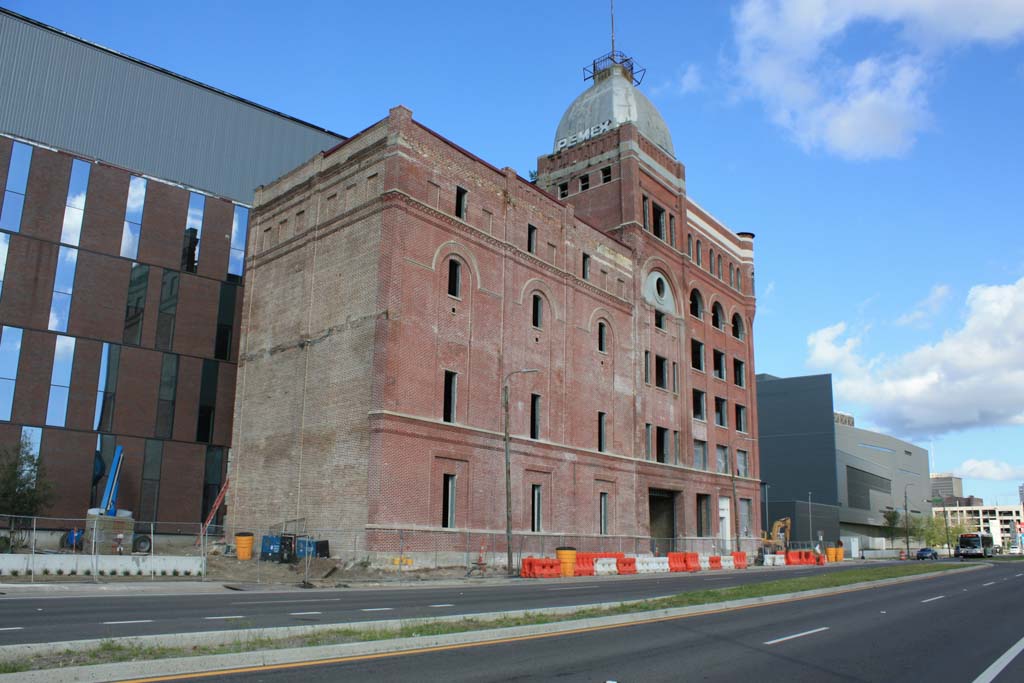
); and the six-story Falstaff Brewery (2600 Gravier Street), closed in 1978 and converted to apartments in 2013 by HMS Architects. Dixie Brewery, designed by a Chicago firm for Valentine Merz, the company’s president, occupied a six-story, steel-framed building of red brick trimmed with white stone. A diminutive corner turret and a tall, silver-painted mansard dome made it an area landmark. Two cylindrical storage tanks on the roof held the rice used in the brewing process, and both tanks were painted to resemble Dixie beer cans. Apart from the giant cans, Dixie had an institutional rather than an industrial appearance and it fit in well with Tulane Avenue’s other buildings. During Prohibition, the brewery manufactured ice and ice cream. Emile Weil designed a four-story extension in 1919. The building was flooded following Hurricane Katrina. Subsequently, the brewery became part of the massive post-Katrina medical center redevelopment project (see
OR89
) and renovated as a research center.
Veterans Affairs Medical Center Research Center (Dixie Brewery)
1907, Louis Lehle and Sons, with Julius Koch; 2017 renovated, Eskew+Dumez+Ripple. 2401 Tulane Ave.