

This column was the first public monument ever erected in Wilmington and incorporates a fragment of one of America's most historic lost structures. In 1868, Latrobe's Bank of Pennsylvania, Philadelphia, was demolished to make way for the U.S. Appraisers' Stores Building. Delaware Civil War veteran Albert S. Nones suggested to U.S. Congressman Charles O'Neill of Philadelphia that its columns be made into war memorials to be designed by the architect Mullett. Congress passed a bill of authorization. Through Nones's leadership, the Soldiers and Sailors Monument Association, Delaware, successfully applied for one of the columns, which formed the basis for the state's only Civil War soldiers memorial. (Other Latrobe-column memorials survive at Adrian, Michigan, and Dayton, Ohio.) Lowe fashioned the globe and eagle (which grapples with the serpent of rebellion), cast at Pusey and Jones Company in Wilmington from donated cannon bronze. The monument was dedicated in May 1871 by General Oliver O. Howard of the Freedman's Bureau. Debts went unpaid, and the sheriff seized the monument for a time. Willam du Pont enclosed the plot with granite copings in 1893 as Monument Place. The landscaping is modern (1978, Edward Bachtle). The surrounding neighborhood has interesting houses of the 1870s–1880s era, although the childhood home of memoirist Henry Seidel Canby (The Age of Confidence, 1934) at 1212 Delaware Avenue was torn down for a 1920s-era apartment house.
Soldiers and Sailors Monument
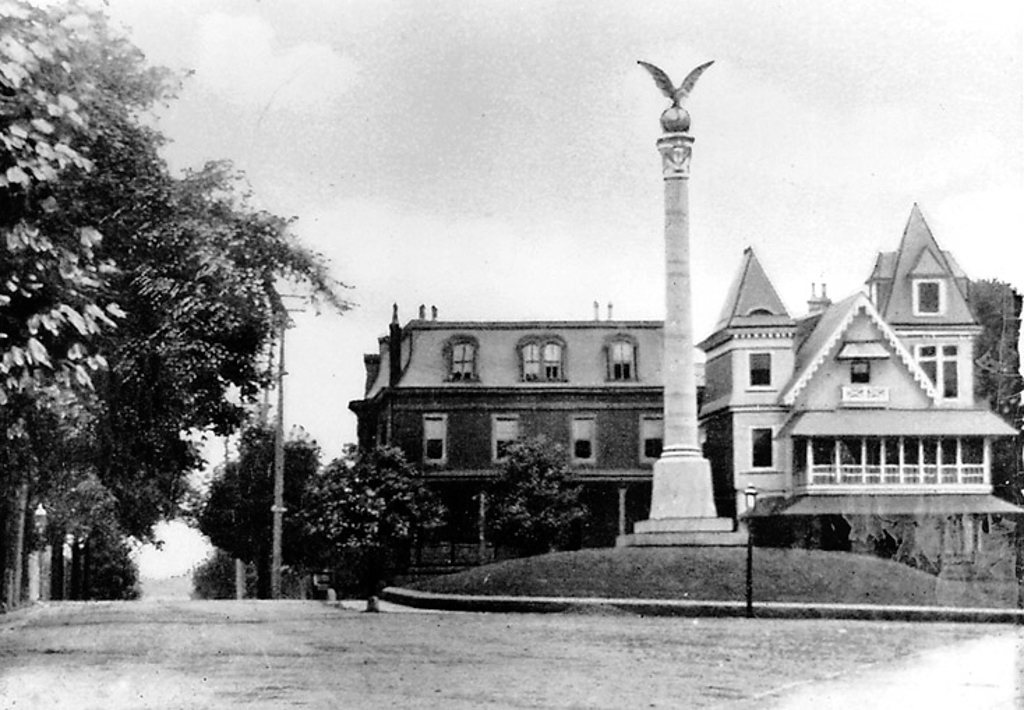 Delaware Postcard Collection, University of Delaware Library, Newark, Del
Soldiers and Sailors Monument
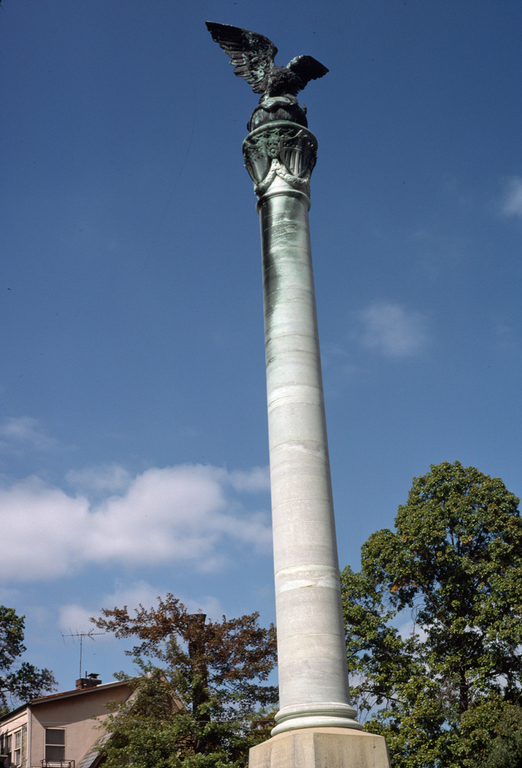
1871, Alfred B. Mullett, incorporating a 1799–1801 column by Benjamin Henry Latrobe; Harry Lowe, sculptor. Delaware Ave. and Broom St.