

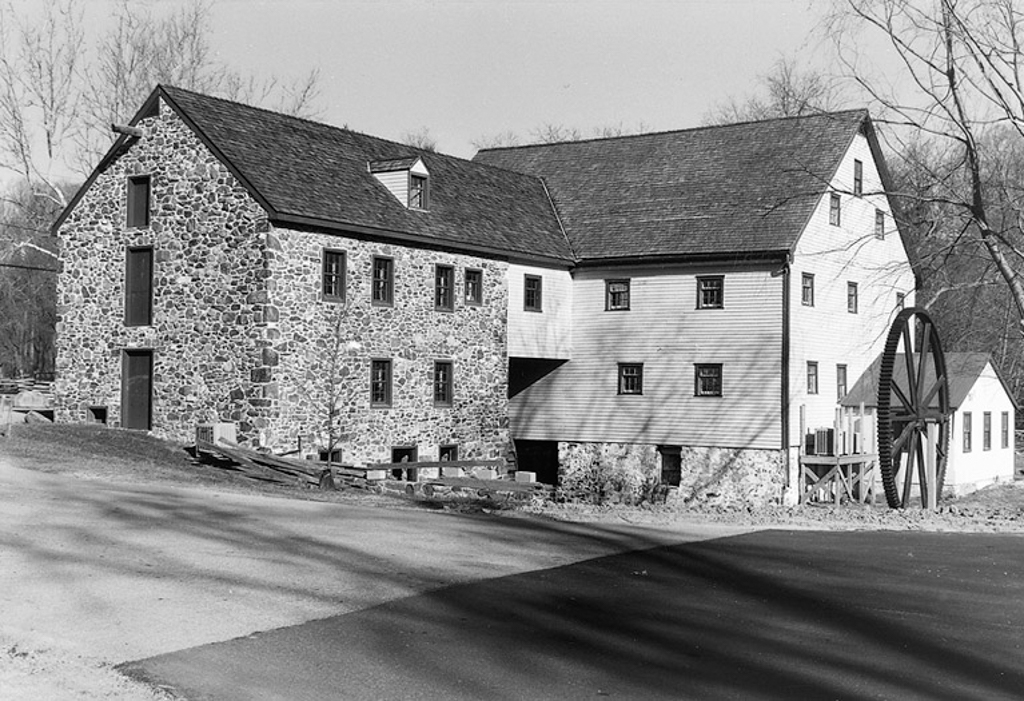
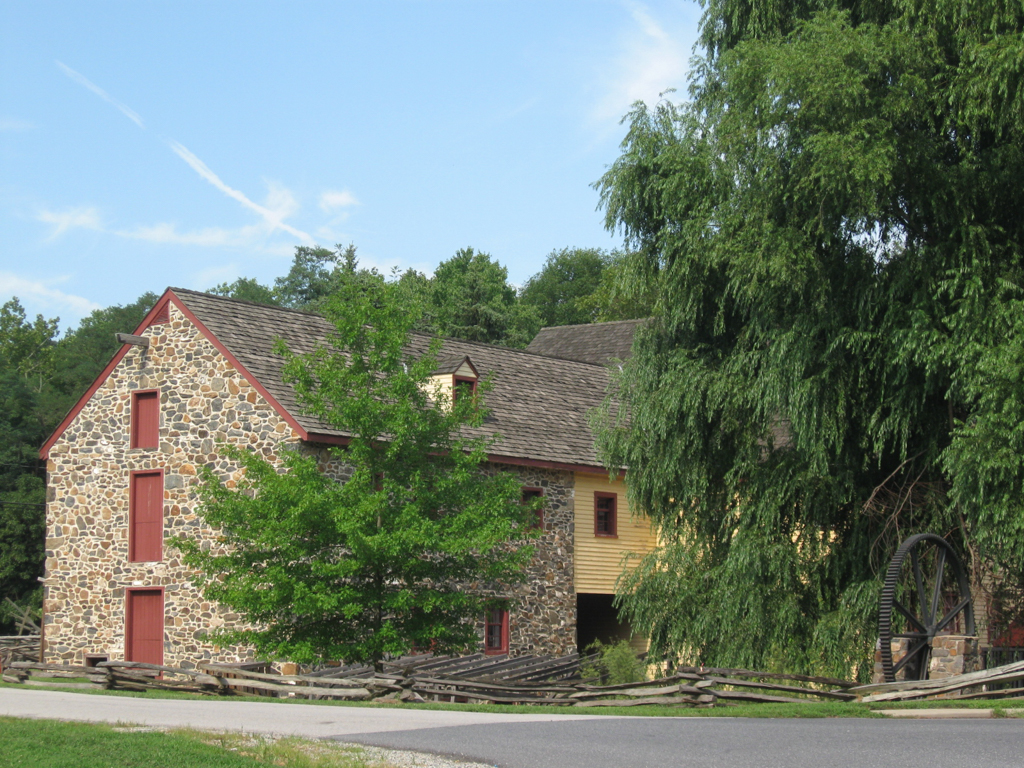
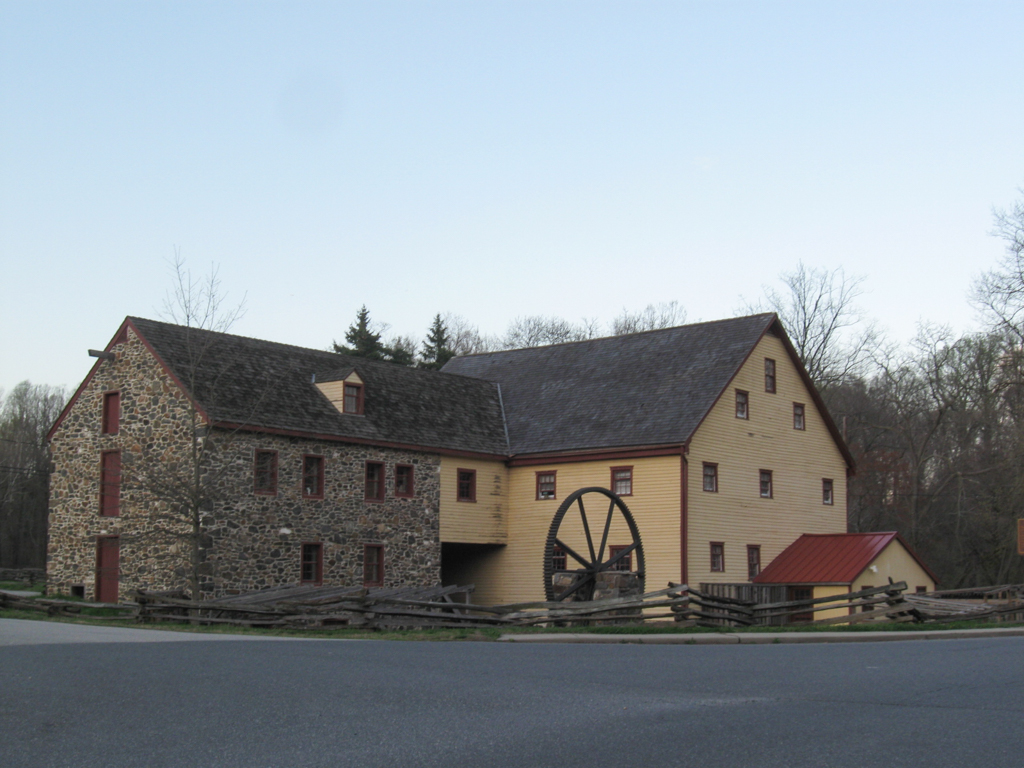
A Swedish mill operated here in the late seventeenth century. The Philips family of Quakers later ran a wooden merchant gristmill to grind flour (1790–1888), modernizing the facility with Oliver Evans equipment in 1793. Their nearby stone farmhouse bears a datestone, “IRP 1794” (for John R. Philips). In 1810, they erected a stone addition to the mill complex as the Madison Factory to process Merino wool. A mansion was built on Newport Gap Pike in 1852 and named Greenbank, the Madison Factory by then making hubs, spokes, and felloes (wheel rims) for the Wilmington carriage industry. The gristmill was still operating in the mid-1960s when Historic Red Clay Valley bought it. In 1969, some youths burned the place, but it has been rebuilt and serves as a living history museum. (A small part of the original survives at the Hagley Museum [
CH15.2
], to which it was transported in the 1950s.) The deteriorated and fire-weakened Madison wing was removed, but subsequently reconstructed, though with stone walls merely as a veneer over frame. Since 1992, many improvements have been carried out, including excavating the extensive raceway and rebuilding the eighteen-foot waterwheel. Archaeology is ongoing beneath the Madison Factory, where a dye house has been identified, a rare find. Future plans call for replicating the kitchen building in which two slaves were housed c. 1820, reconstructing a vertical sawmill, and renovating the bank barn of c. 1850.
Greenbank Mill
1983–1996 rebuilding of c. 1760 and 1810 structures, Charles du Pont and others. Greenbank Rd. at Red Clay Creek, 0.1 miles northeast of Newport Gap Pike (DE 41)