

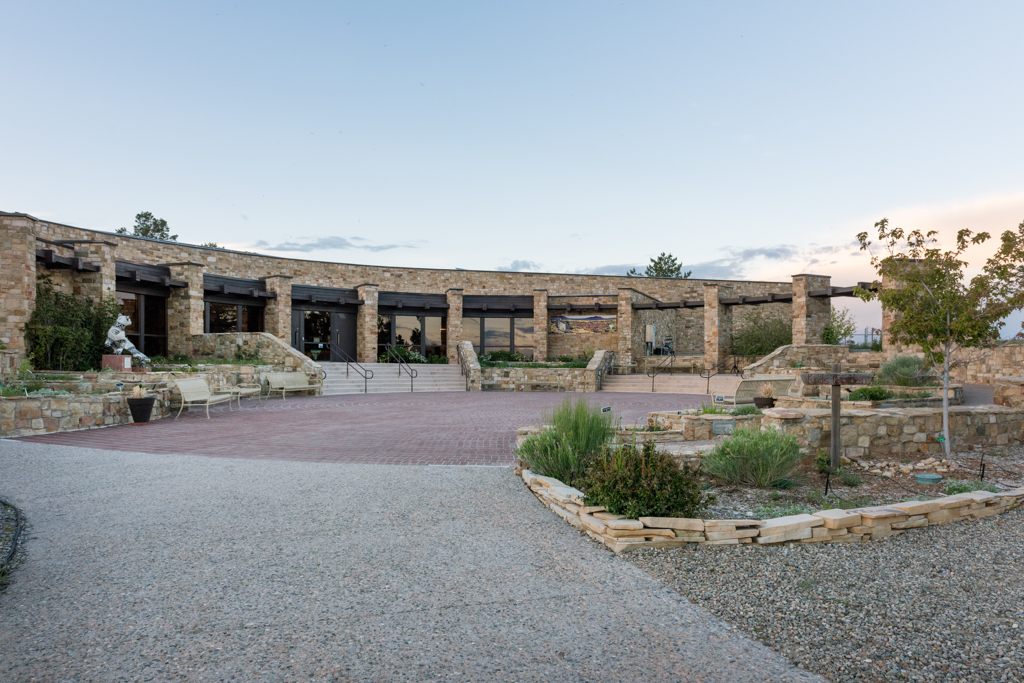
Built as part of the mitigation for many Anasazi sites drowned by the huge McPhee Reservoir project, this $4.8 million, state-of-the-art museum preserves and exhibits some of the artifacts salvaged from what is now Colorado's second largest lake. Stone from cuts for the McPhee Dam went into the walls of the Neo–Pueblo Revival complex. The structure is a one-story semicircle, designed to catch sunlight, which is visually extended into a circle by an open-beam pergola and curving walls. The 40,500-square-foot museum houses not only artifacts, but also archives, a theater, a conference center, a library, hands-on exhibits, and a full-scale reconstructed pit house. Trails lead to the nearby Dominguez and Escalante ruins, two important excavated Anasazi sites first discovered in 1776 by Fathers Dominguez and Escalante. The Escalante ruin is notable as an example of Chaco Canyon–type masonry, consisting of stone blocks alternating with bands of smaller stones, or spalls, enclosing a core of sandstone rubble.
Anasazi Heritage Center
1988, Curt Lamprecht and Gayle Erickson, Bureau of Reclamation architects. 27501 Colorado 184, 2 miles west of Dolores