

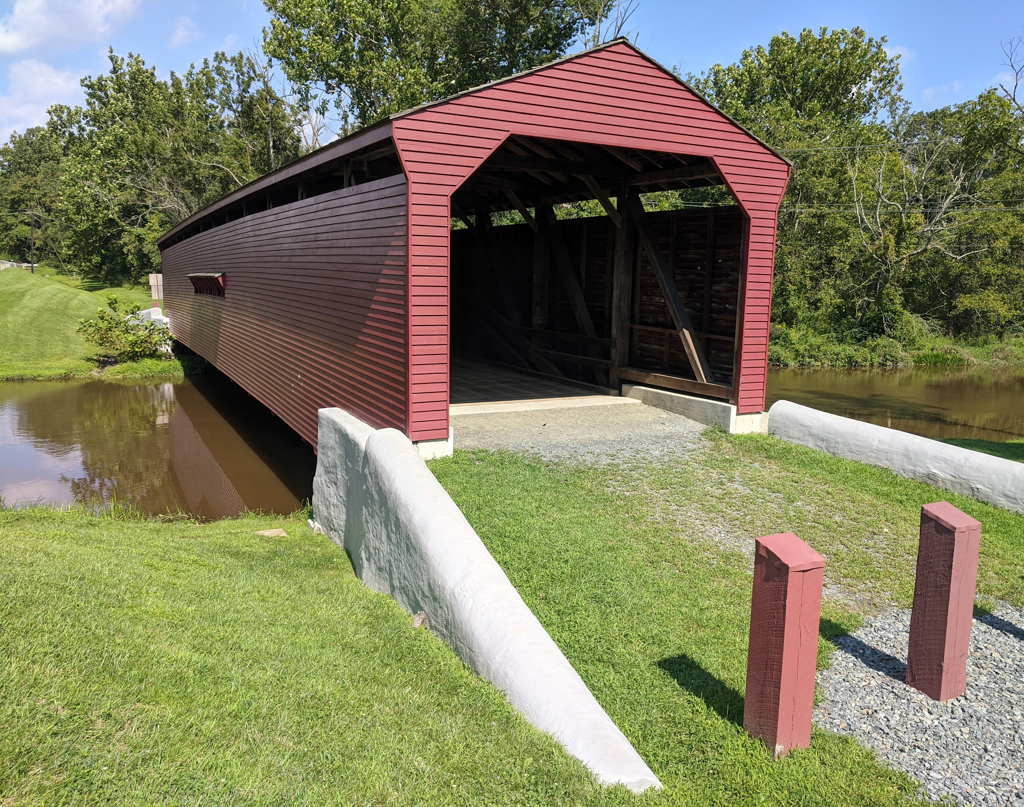
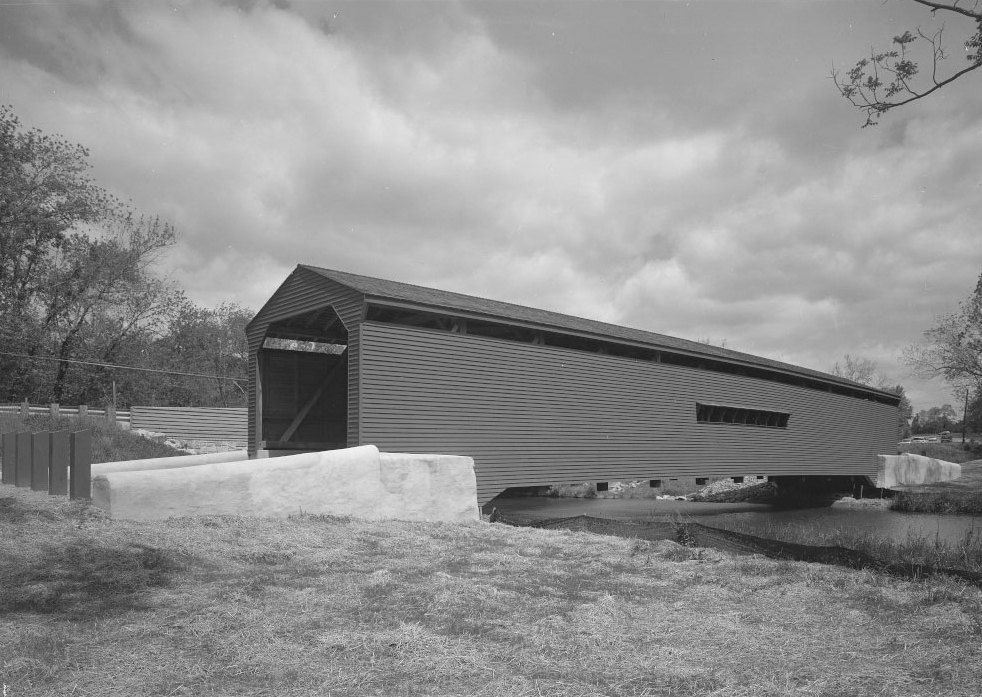
Maryland’s streams and creeks were once traversed by dozens of wood-covered bridges, particularly along the many Susquehanna River tributaries. Local master bridge builder Joseph G. Johnson used engineer Theodore Burr’s 1817 patent design for this bridge commissioned by Cecil County. Samuel Gilpin first harnessed the nearby falls of North East Creek to power his flour and sawmill in 1735. Widely popular during the era of gable-roof covered-bridge building in the nineteenth century, the Burr Arch combined multiple king post trusses with large parabolic arches to create a sturdy heavy-timber bridge design. Here a single span sits on stone abutments. Vehicular use of the bridge was discontinued in 1936; today it sits parallel to MD 272. Repairs were made to the bridge in 1932, 1959, and 1971, and a major rehabilitation in 2009–2010. At 119-feet-long, Gilpin’s Falls is the longest of the six surviving covered bridges in Maryland. Jericho Covered Bridge in Harford County also used a Burr Arch design.
GILPIN’S FALLS COVERED BRIDGE
1859–1860, Joseph G. Johnson, builder; 2009–2010, rehabilitated. 1199 North East Rd. over North East Creek