

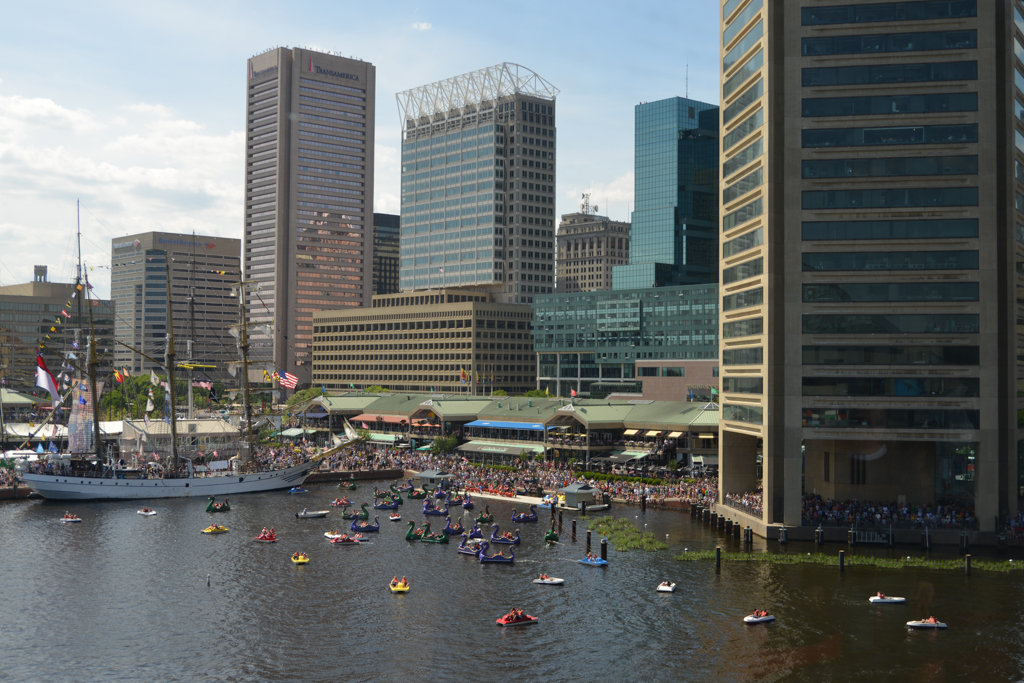
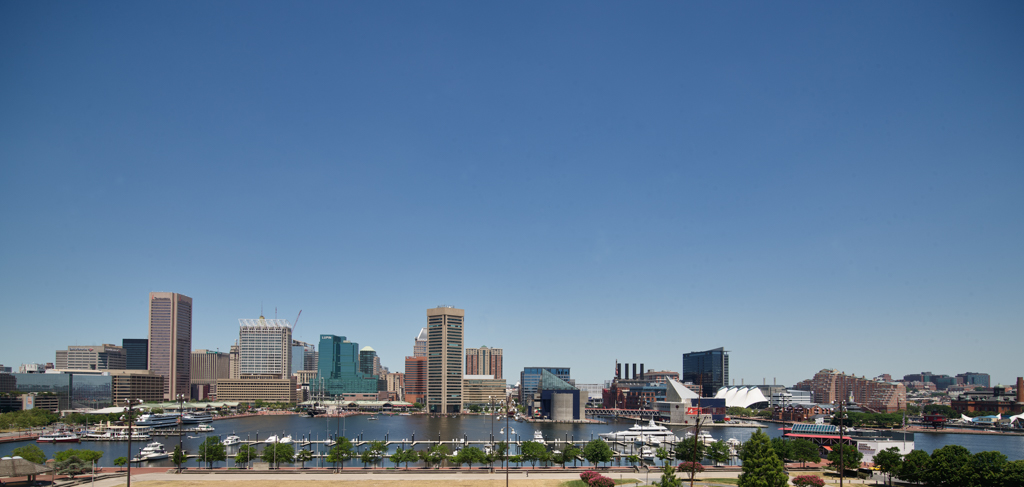
The Inner Harbor of Baltimore’s deepwater port on the Patapsco River was transformed in the 1970s and 1980s from a gritty mix of industrial and commercial uses into a tourist and entertainment destination. Postwar proposals for aggressive interstate highway construction would have run a bridge across the Inner Harbor to link I-95 to the Jones Falls Expressway and an East
–
West Expressway along the north side. Public outcry ensued, and early efforts were launched to reclaim land around the Inner Harbor for public use. The Inner Harbor Master Plan of 1964 was a direct outgrowth of the early success of Charles Center, and its implementation was overseen by a new city agency created in 1965, Charles Center
–
Inner Harbor Management. Through this mechanism, city planners enforced design guidelines and arranged the massing of buildings around the Inner Harbor to foreground lower, more sculptural structures framed from behind by mid-rise buildings and tall towers. By the 1970s parks, a brick promenade along the water, and a few key commercial projects such as the United States Fidelity and Guaranty (USF&G) Life Insurance Company’s forty-story tower (now the Transamerica Tower) and the World Trade Center were in place.
The original idea was to reclaim the waterfront for Baltimore residents—few people conceived that Baltimore could attract large numbers of visitors. Attitudes began to change with the popularity of the visiting tall ships during the 1976 Bicentennial celebration and the opening of the Maryland Science Center (1971–1975, Edward Durell Stone; 601 Light Street). Also important was the docking of the 1854 sloop-of-war the USS Constellation as a permanent attraction, thought to be the original 1797 frigate with modifications. However, it was developer James Rouse’s controversial Harborplace festival market-place project that provided a catalyst for the final transformation of the Inner Harbor into a tourist destination. The National Aquarium and Baltimore Hyatt Regency (A. Epstein and Sons and RTKL Associates; 300 Light) followed shortly thereafter, both opening in 1981.
Today predominately late-twentieth-century construction around the Inner Harbor is accompanied by a few historic survivors. Maritime history is represented by the USS Constellation and other attractions managed by Historic Ships of Baltimore, including the Seven Foot Knoll Lighthouse (1855). Relocated to Pier 5 from the mouth of the Patapsco River in 1988, it is a screw-pile lighthouse typical of the Chesapeake Bay. Another nod to the history of the Inner Harbor includes preservation of the Pratt Street Power Plant (1900–1909, Baldwin and Pennington; 601 E. Pratt Street) as a mixed-use project. Standing in dramatic contrast across the slip on Pier 5, the tent-like fiberglass-reinforced Teflon roof of the Columbus Center (1995, Eberhard Zeidler; 701 E. Pratt) houses event space and a technology incubator now owned by the University System of Maryland. A small glass-walled pavilion with a swooping roofline was added to the park on the west edge of the Inner Harbor in 2004, bringing the architectural ensemble up to the twenty-first century and serving tourists as the Baltimore Visitor Center (2004, Design Collective; 401 Light).
More recent development of hotels and other commercial structures to the east is a testament to the Inner Harbor’s continued success as a tourist and convention draw. The transformation of a working harbor into an entertainment district signaled the reinvention of Baltimore to a regional and national audience while, for better or worse, embodying shifts from production to consumption as a catalyst for the American economy.