

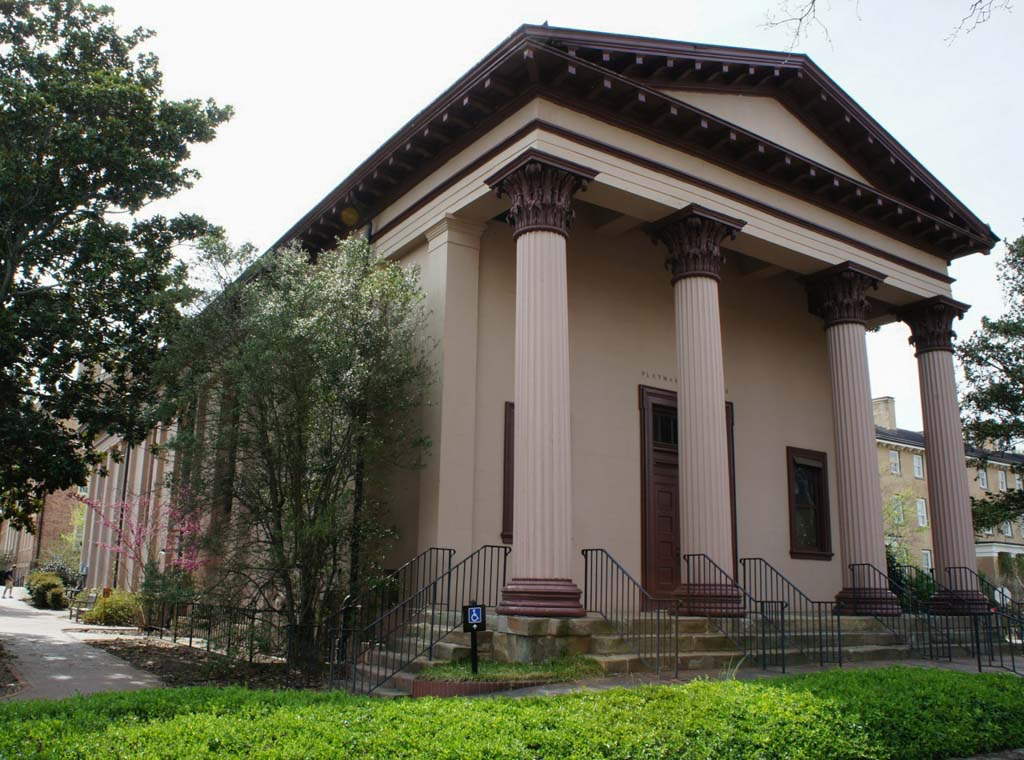
The Playmakers Theatre is one of the architectural treasures of the University of North Carolina campus. Designed by Town and Davis, the building resembles a Greek temple. It sits on the northeast corner of Polk Place, a quad that includes other historically important buildings such as Wilson Library, and is adjacent to the South Building (now the main administration building) on a prominent site within the central part of campus.
The building originally served as an assembly hall. In 1833, the request for such a building was submitted to the board of trustees but was initially denied. Fifteen years later, students submitted a second petition for a building that would house a meeting place for the new alumni association and for the trustees, and a once-a-year commencement ballroom; the petition was granted for what was originally known as Smith Hall.
At the time of construction, university president David Swain had already begun visionary improvements to the campus at Chapel Hill. He had acquired the services of New York–based architect Alexander J. Davis, who had recently worked on the North Carolina State Capitol. Swain believed that a classical architectural style would provide an intellectually inspiring atmosphere on his rural university. Local builders Henry Richards and John Berry (who had recently completed the Greek Revival Orange County Courthouse) carried out Davis’s plan for the new assembly hall.
The building is a Greek temple form with an east-facing portico. The exterior lacks heavy ornament, save the four Corinthian columns with capitals fashioned to represent ears of corn rather than acanthus leaves—a detail that ties the sophisticated building to the rural farming history of the state. Davis’s columns reference Henry Latrobe’s “corn order” on the U.S. Capitol. The northern and southern elevations are divided into fourteen bays by stucco pilasters, which terminate at the entablature. Nine-over-nine sash windows occupy alternating bays. The building is constructed primarily of brick, but Davis attempted to give Smith Hall a more important presence by stuccoing the clay masonry and painting it to resemble stone.
In addition to its originally intended use, the building has also served as a chemistry laboratory and a bathhouse. It once even quartered Union soldiers’ horses. In 1925, the building was repurposed into the Playmakers Theatre. The renovation included removal of the floor separating the two levels, the addition of a proscenium framing a new stage at the west end, conversion of the basement into dressing rooms, and installation of electric stage lighting. The nationally renowned Carolina Playmakers occupied the space until the construction of another facility in 1976. The North Carolina Arts Council and the National Endowment for the Arts currently support the Playmakers Theater.