

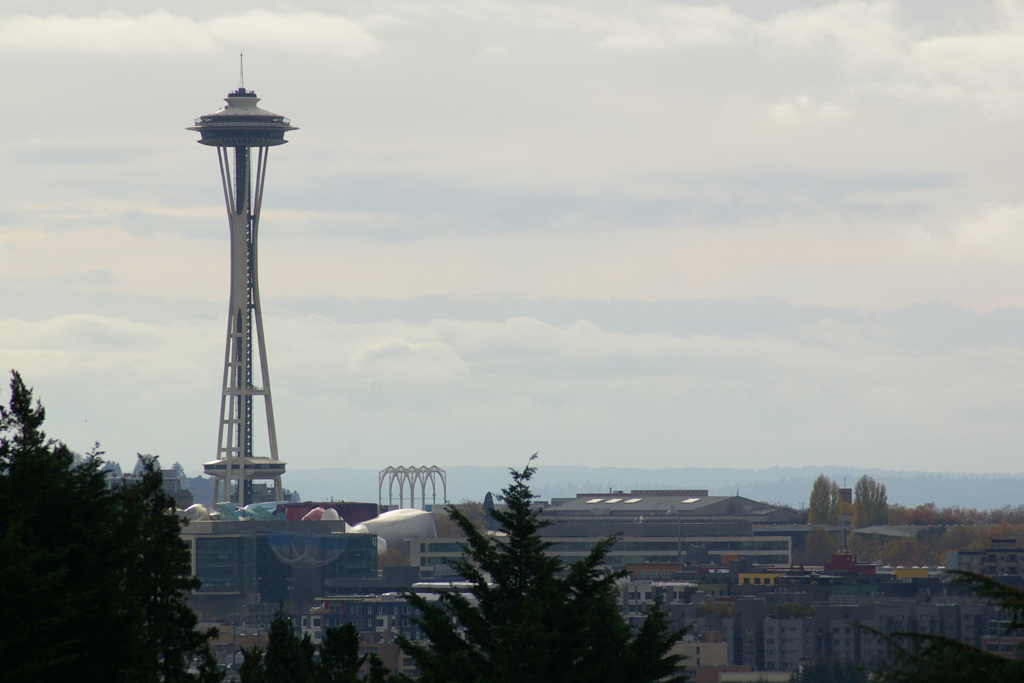
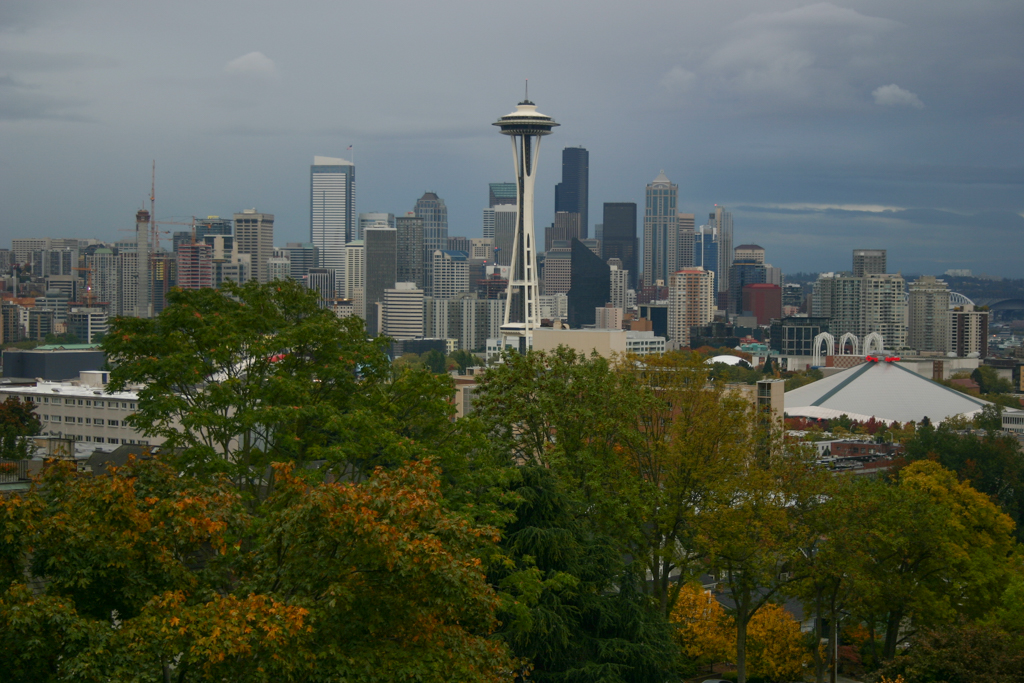
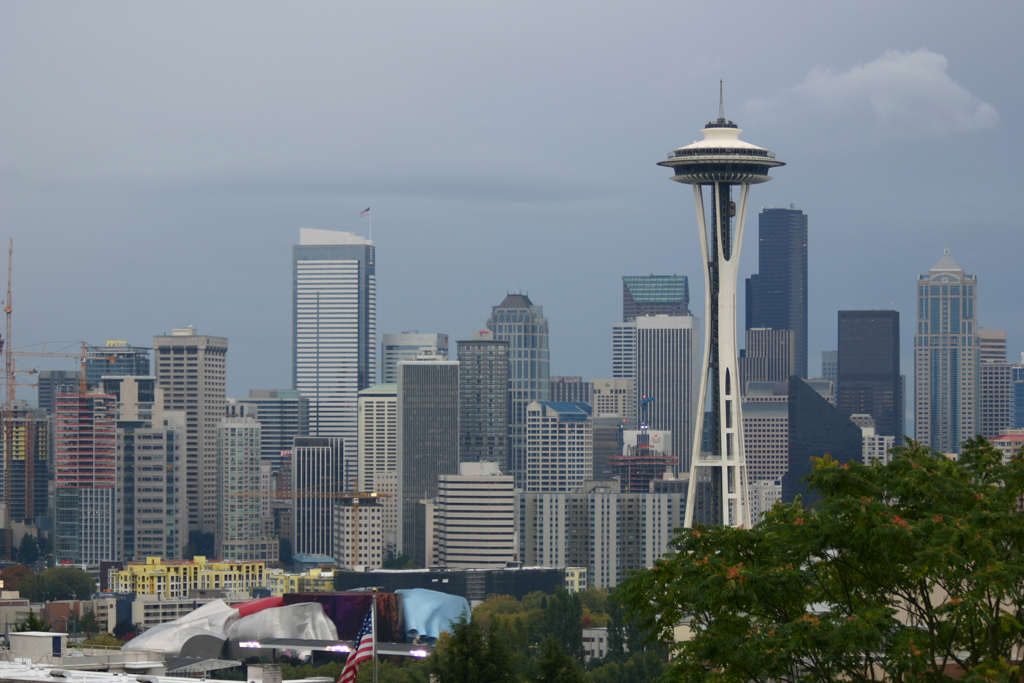
The site of the iconic Space Needle and the setting for the Century 21 Exposition in 1962, the Seattle Center is a premier attraction for both city residents and visitors. Occupying some 74 acres just north of downtown at the foot of Queen Anne Hill, the center includes some 34 civic-oriented buildings and a variety of open spaces that have hosted major civic celebrations and festivals over the years. Although its history dates back more than a century, the center’s defining moment and arguably its most identifiable landmarks are associated with the mid-twentieth-century years surrounding the world’s fair that celebrated technology and progress—and helped promote the space age.
The Seattle Center’s legacy as a civic center, however, dates back as early as 1911—and possibly before. Originally part of David and Louisa Boren Denny’s 1853 donation land claim, in the late nineteenth century the area was a neighborhood consisting of wood-framed residences, some small businesses, and a few boarding houses. The nearby Western Mill, at the southern end of Lake Union, employed many of the neighborhood residents, and the Warren Avenue School and adjoining Mercer Playground also occupied space on the site. The idea of creating a more formal civic center to serve as Seattle’s cultural gathering place was put forward by Virgil Bogue in an elaborate, but ultimately unrealized, plan for Seattle in 1911. The significance of the plan, which has come to be known as the “Bogue Plan,” is that it generated interest in a civic center, recommending its placement in a central area—yet one slightly removed from the downtown business district. The selection of the present-day Seattle Center site emerged from this plan.
The formal development of the land began in April 1926, when Seattle’s Chamber of Commerce purchased a four-block site on lower Queen Anne and announced plans to build a civic auditorium. The impetus for the purchase was a bequest from pioneer James Osborne, who stipulated that his gift should fund “a public hall.” Along with the hall, a sports field and display hall were also planned. Other buildings constructed in the adjacent area in the late 1920s included the Civic Auditorium/Exposition Hall, the Civic Ice Arena, the Civic Field, and the small Veterans of Foreign Wars facility, which also served as a fieldhouse. Many of the new buildings, including the multipurpose 1939 Washington National Guard Armory, hosted events and dances and drew people from throughout the area. Memorial Stadium, named for Seattle-area high school students who had lost their lives in World War II, was added in 1947 when the Seattle area high schools outgrew Civic Field. As Seattle’s population surged, the area was quickly becoming a center for the entire region.
Criticism of the existing facilities at the site also began to surge. Music aficionados, especially symphony-goers, complained in particular about the acoustics and seating configuration of the large, barn-like interior of the 1920s Civic Auditorium. This led to the formation of a civic arts committee, which—in addition to various specifics related to the arts—also recommended the creation of an even larger civic center to Seattle Mayor William F. Devin in 1946. Members of the arts committee formally incorporated as the Seattle Civic Center Association in late 1947, and the Association built support for an expanded civic center.
As Seattle transitioned from war to peacetime in the late 1940s and early 1950s, the city experienced an enormous amount of growth and change. Seattle’s aerospace and maritime industries had been crucial to the war effort, and urban boosters now began to promote a future of leisure, comfort, relaxation, and unlimited potential through science and technology. In 1954, a dedicated group of Seattle boosters generated support for a world’s fair to celebrate this legacy. What later became the Seattle World’s Fair Commission conducted a study that concluded the optimal location for the fair would be the site already occupied by several civic buildings. On November 6, 1956, Seattle voters approved a $7.5 million bond issue to acquire additional land needed for what would become the Century 21 Exposition, and the World’s Fair Commission and the Civic Center Advisory Commission began working together to develop the site.
A host of individuals were involved with the planning and design of the fair. This included a design commission with designers with rising national reputations, including Minoru Yamasaki and Lawrence Halprin, as well as local designers such as Perry Johanson, John Detlie, Robert Deitz, and Paul Thiry. In August 1958, Thiry was appointed primary architect for the joint civic center-world’s fair project. Thiry and architect Clayton Young worked together to ensure that pre-fair decisions were compatible with post-fair goals. Thiry was responsible for approving the numerous building designs created by different architects.
As planning got underway, the existing school, playground, and more than 200 other structures were demolished to make way for new construction, while the Memorial Stadium, Armory, and a few existing structures were renovated for new uses. Memorial Stadium was leased from Seattle Public Schools, the Armory was leased from the Washington National Guard, and the Nile Shrine Temple was leased from the Nile Temple Holding Company. While the existing street grid was largely retained, the entire area was made off-limits to motor vehicles. The site was officially named “Seattle Center” on February 28, 1961, and the fair opened on April 21, 1962 with five themed futuristic “worlds”: Tomorrow, Science, Art, Entertainment, and Commerce and Industry. Over its six-month span, the fair hosted 10 million visitors to its many pavilions, exhibits, and attractions, including the Space Needle, the Monorail, the Washington State Coliseum (now Key Arena), and the Science Pavilion (now Pacific Science Center)—all built anew for the fair.
An early decision had been made that the fair site would be given back to the public once the main event was over. Temporary buildings were demolished or sold for salvage, and permanent buildings transitioned to their post-fair functions. Memorial Stadium, for example, was returned to the Seattle Public Schools, although the Armory lease was continued and the building eventually purchased by the city for use by the Seattle Center. The Washington State Coliseum was transformed into the Key Arena and the International Commerce and Industry buildings were altered to support civic activities. The popularity of the Science Pavilion and the Space Needle ensured they would remain as visitor attractions for the new Seattle Center.
Planners hoped to better integrate the site into the fabric of the city following the fair, as well, although it would be several decades before such integration became apparent. The original fair layout oriented buildings to channel visitors to four main entrances, creating a wall isolating the site from the city. In late 1989, however, the Broad Street Green was created by demolishing the fair’s massive, 500-foot-long Domestic Commerce and Industry Building (also called Building 55). Seattle Center’s Century 21 Master Plan, adopted in August 2008, further recommended open space connections between the center and the city, in addition to greater connections between spaces within the Seattle Center.
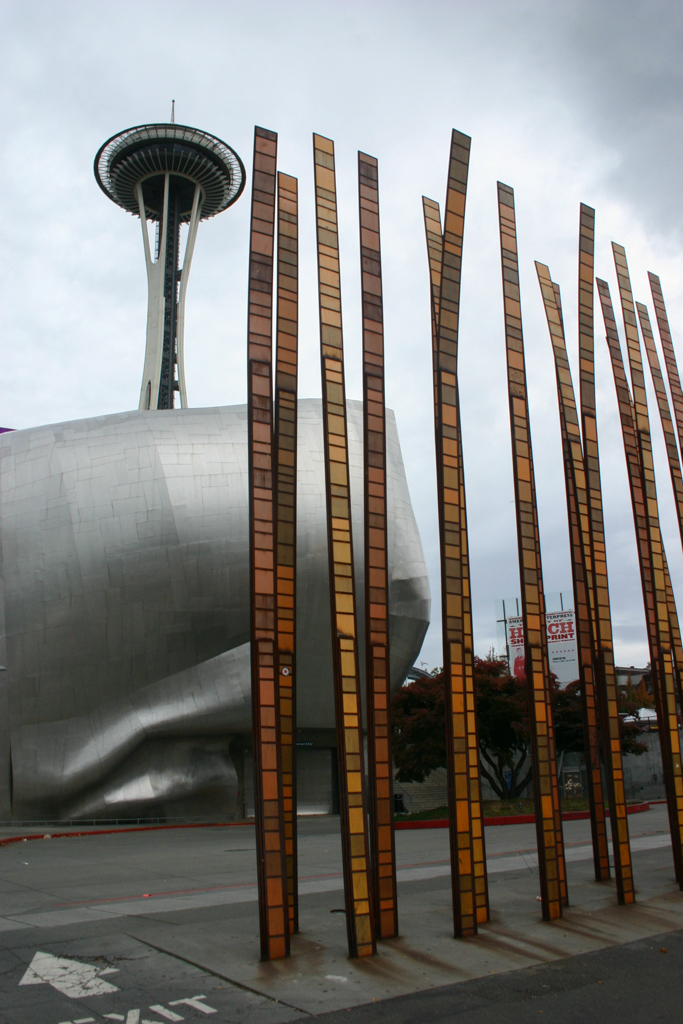
As Seattle’s population, demographics, and economy shifted over the years, what Seattle’s citizens asked of the Seattle Center also changed and evolved. This has created several challenges with regard to the built environment: city officials have wished to encourage growth while celebrating the fair’s legacy, yet have been faced with deterioration in virtually all of the fair-era buildings. Nonetheless, a number of bond measure approvals have given the Seattle Center the ability to patch and repair several of its buildings, and public/private partnerships have assisted as well. New development since the turn of the millennium has also added to the overall appeal of the center as well as keeping pace with the developing interests of different age groups within the city. This includes the Experience Music Project (now the Museum of Popular Culture), the Chihuly Garden and Glass, McCaw Hall, the Seattle Children’s Theatre, the Skate Park, and the Vera Project.
The Seattle Center has now served the Seattle community, the region, and the world for half a century, arguably meeting—even exceeding—the goals of fair founders and the earliest boosters for a civic center. Many fledgling arts organizations have found steady footing within the Seattle Center’s buildings, and several significant events in the history of the city have been held there including a Beatles concert in 1964, a King Tut Exhibition in 1978, an impromptu gathering at the International Fountain following September 11, 2001, and appearances by the Dalai Lama and Barack Obama in 2008. Today, the Folklife Festival and Bumbershoot international music and arts festival pack the Seattle Center with an array of people whose backgrounds and cultures reflect the ever-diversifying city. The Seattle Center may not be in the heart of downtown, but the city has adopted it as a kind of center nonetheless. The rest of the world, meanwhile, continues to be drawn to it: in 2016, the Seattle Center hosted more than 2.2 million visitors, making it Washington’s biggest tourist attraction.