

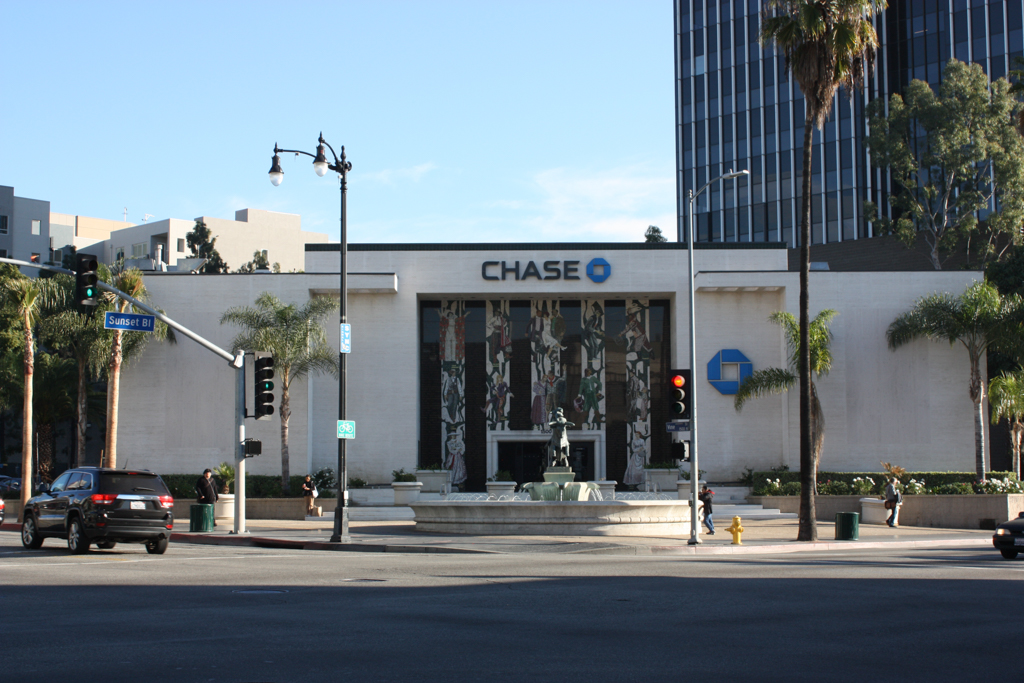
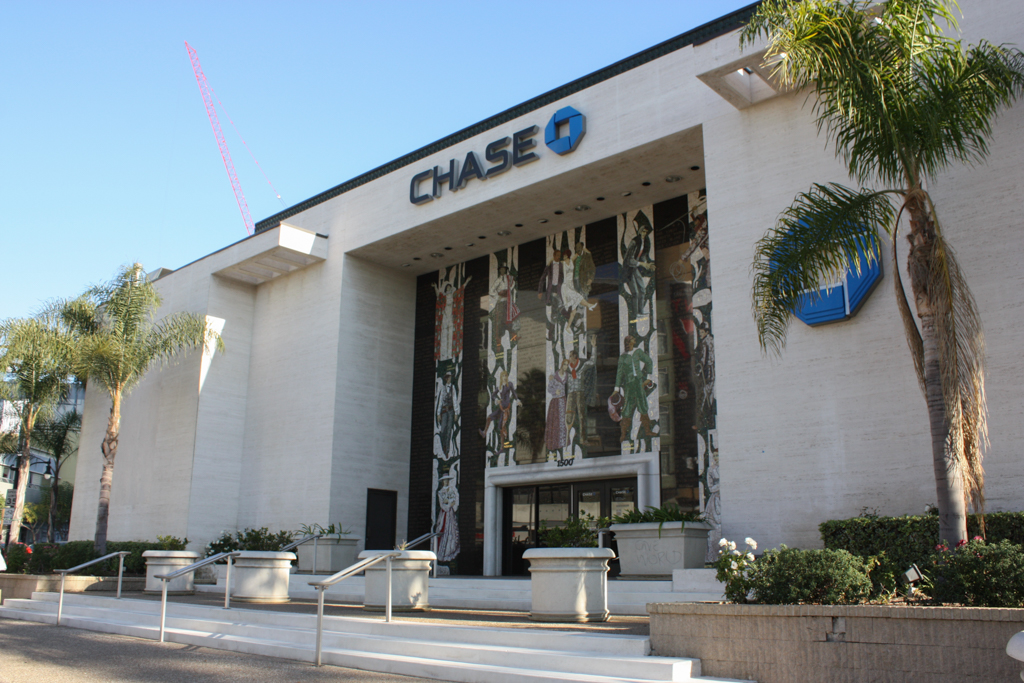
Built in 1968, the Chase Bank in Hollywood is one of over forty branches designed by the artist Millard Sheets for Home Savings of America. Sheets’s now iconic designs were instantly recognizable and extremely successful, drawing record numbers of patrons because, as the artist said, “people wanted to be associated with something beautiful.” Over the course of his career, Sheets designed many mural-bearing bank buildings. Yet he considered this one particularly successful, calling it a “little special plum” among the larger structures. Built in the New Formalist style, the simple white structure stands out as a seminal project in his career.
Sheets gained the commission from Home Savings and Loan owner, Howard Ahmanson, whose company made home loans to Southern Californians during the postwar building boom. Ahmanson admired Sheets’s work and, in 1953, he hired him to design two buildings on Wilshire Boulevard. At the time, Sheets was strictly an artist with no formal architectural experience. The designs proved wildly successful, and Sheets would design over forty more Home Savings branches over the next twenty-one years. As an artist first and architect second, Sheets believed that art should be integral to a building. He designed mosaics, painted murals, and sculpture into nearly all of his buildings, collaborating often with renowned artists of the era. The aesthetic of fine materials was very important to him, and the financial success of the buildings enabled him to continue using the best.
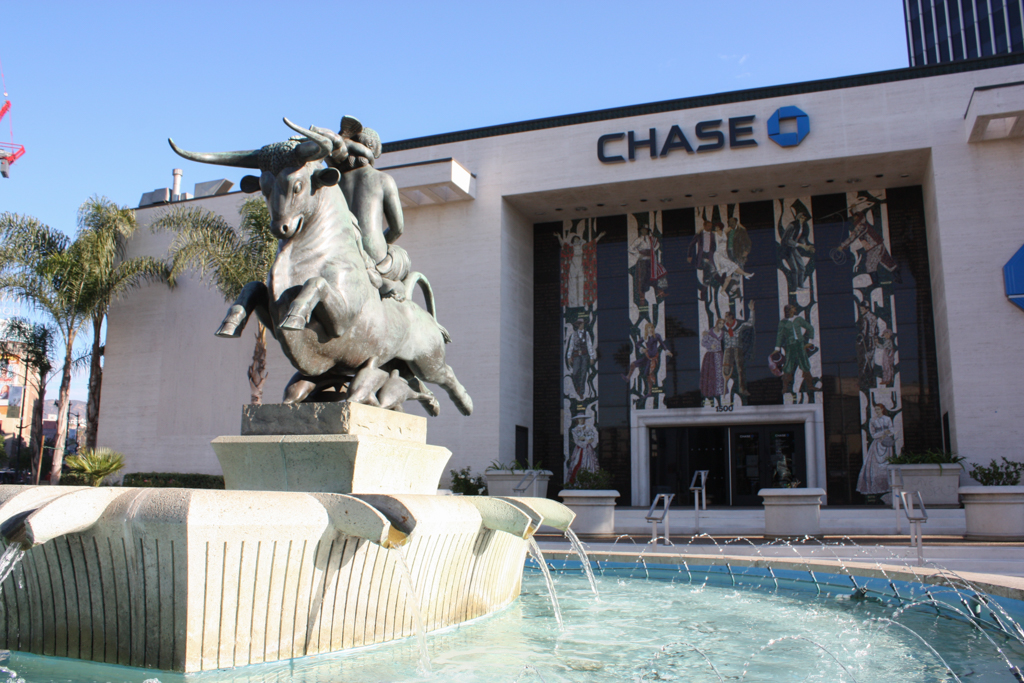
The Hollywood branch sits at an angle on its site, facing the major intersection of Sunset Boulevard and Vine Street. It features three mosaic murals, one of which covers nearly the entire facade of the two-story building. The murals depict more than fifteen legendary movie stars in their best-known roles. The murals are backed by a series of black marble panels inscribed with the names of 480 other famous Hollywood entertainers. The art is a nod to the site’s history not only in the heart of Hollywood, but also as the filming location for Hollywood’s first full-length motion picture, The Squaw Man (1913).
In front of the bank sits a large fountain surrounding a Paul Manship sculpture of Europa riding Zeus in bull form. This piece further establishes the corner as a landmark and meeting place. Susan Hertel, Sheets’s most frequent collaborator, designed the stained glass windows on the rear of the building facing the parking lot. The windows’ narrative continues the nod to Hollywood history by depicting famous film chase scenes, from Keystone Kops to Moby Dick.