

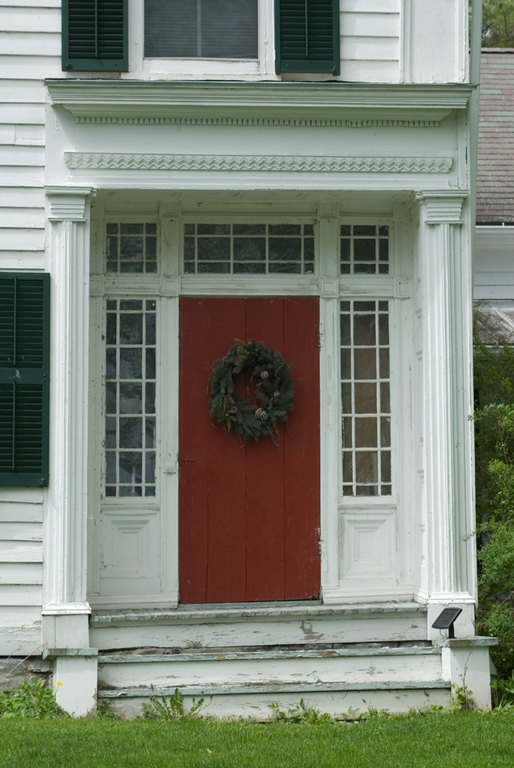
South Hero's first Congregational pastor, Asa Lyons, sold this village lot to his successor, the Reverend Orville G. Wheeler, who served the nearby church from 1840 to 1867. Wheeler also held a number of political offices and was instrumental in promoting the construction of the South Hero–Milton Bridge, which opened in 1850. About that time, Wheeler erected this two-story house. It is a vernacular type of considerable quality at a time when Grand Isle's isolation was just ending. The house combines solid plank walls, brick nogging, and a remarkable Greek Revival frontispiece executed with a sensibility more common in English Canada. The entrance pilasters and capitals use simple staggered and applied cut boards to create shadows for their flutes, necking, and cornice. An applied entablature rests partially atop the capitals so that its elegant dentiled and cornered cornice is no wider than the pilasters. The architrave cornice has a carved chevron pattern identical to one on the main entrance of the Willow Bay Tavern (1849) in Milton just across the bridge, and is probably by the same finish carpenter who detailed that transitional Federal/Greek Revival house. The shadow play continues with intricate five-step recessed rectangular panels beneath the sidelights, although the recessed door, sidelights, and transom are divided by the more common fluted architrave, corner blocks, and parallel muntins.
Reverend Wheeler House
c. 1850. South St., 0.3 miles south of U.S. 2, South Hero village