

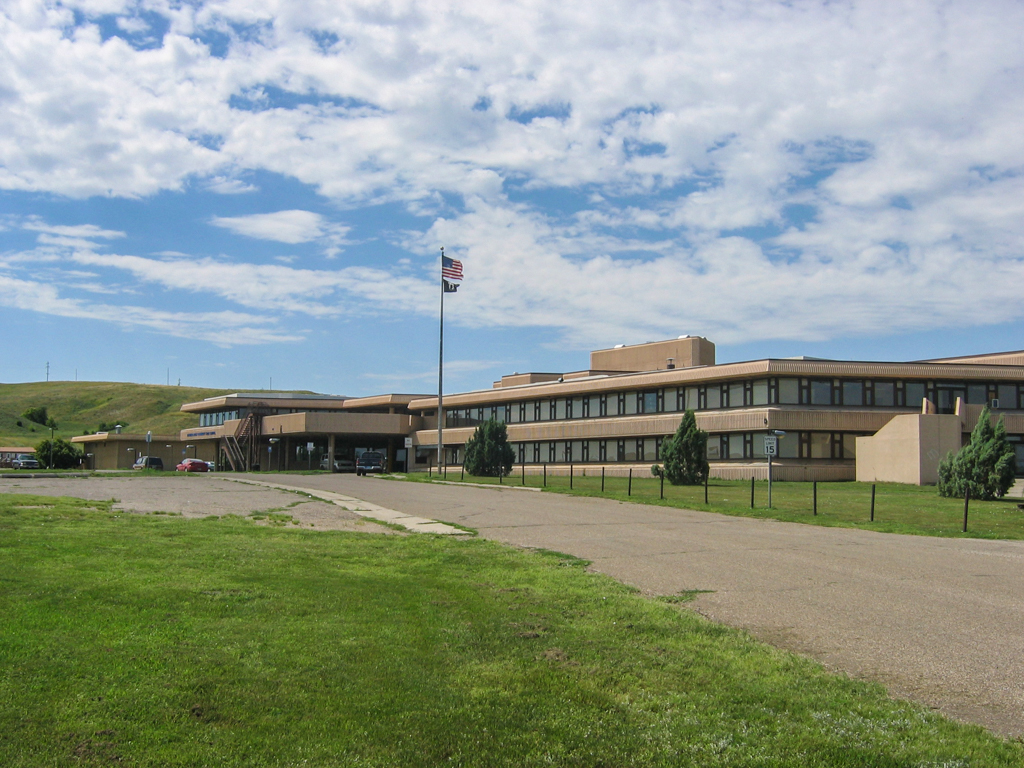
Standing Rock Community High School may seem culturally out of place on the Standing Rock Reservation of the Hunkpapa Lakota, Blackfeet, and Yanktonai Oyate nation that comprises the whole of Sioux County. It was designed according to an open-plan concept arrived at by the tribal building committee and Bureau of Indian Affairs (BIA) officials in consultation with the architects. The student commons is a key, centralizing feature of the design, with a complicated system of linking ramps and a fairly inflexible system of triangular coffers used throughout the building’s concrete waffle-slab construction. The expansive open plan does not seem to work especially well in this instance, commonly cited by teachers and students as a noisy, distracting learning environment. The horizontality of the spandrel bands of ribbed concrete superficially acknowledge the bluffs beyond, but the unrelieved repetition and monotony of the window bands impart a sad feeling of inescapable bureaucracy, affirmed by the cells of the concrete-floor decks inside. Early architectural concepts were based on the school being partially recessed into the hillside, but geological faults necessitated final siting of the building higher on the bluff overlooking the Missouri River. Owing to long-standing cultural conflicts, including much controversy over the murder and secret burial of the Hunkpapa Lakota holy man Sitting Bull, some visitors to the Standing Rock Reservation have found it, perhaps understandably, unwelcoming.
Standing Rock Community High School
1978, Mutchler, Twichell and Lynch, and Clark and Holman. West side of ND 24, 0.25 miles north of 92nd St., Standing Rock Reservation of the Lakota Sioux Nation