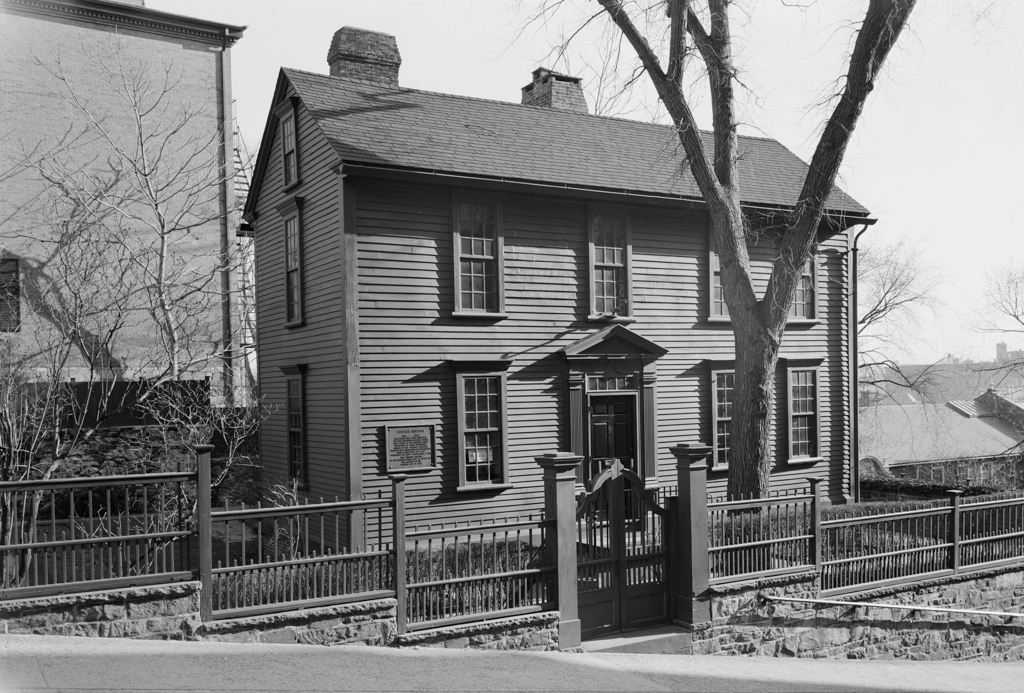
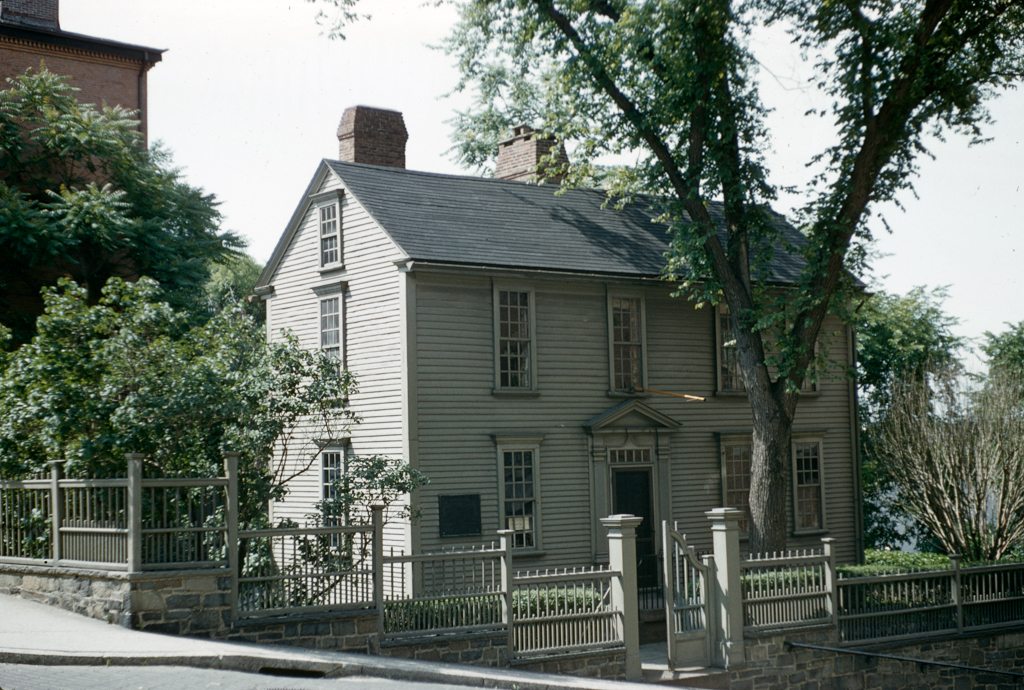
John Field's one-and-one-story gabled cottage comprises the rear ell for the two-and-one-half-story, four-bay enlargement (also quite small) which Stephen Hopkins placed in front of it. The latter is a narrow, two-room house with center hall on the ground floor. A tiny setting for large accomplishment: Hopkins was a merchant who was active in some of John Brown's enterprises, championed independence, signed the Declaration of Independence for Rhode Island, and served ten terms as governor. His house is twice removed from its original location on South Main Street at the foot of Hopkins, most recently for the construction of the Providence County Courthouse across Hopkins Street. Now owned by the state of Rhode Island and managed by the National Society of the Colonial Dames of America, it stands as Norman Isham interpreted it in the 1920s for a house museum. Although it is remarkably intact inside, the front entrance is Isham's, based on equivalent examples from the 1740s. Alden Hopkins, a descendent, who designed gardens for the early phases of restoration at Colonial Williamsburg, produced the formal, terraced garden, characteristic of the eighteenth century, but not of Providence. A diminutive thing in a diminutive garden, the house seems somehow unreal in its idealization and slightly aloft on its terrace, as though wafted on a magic carpet out of a Colonial Revival dream.