

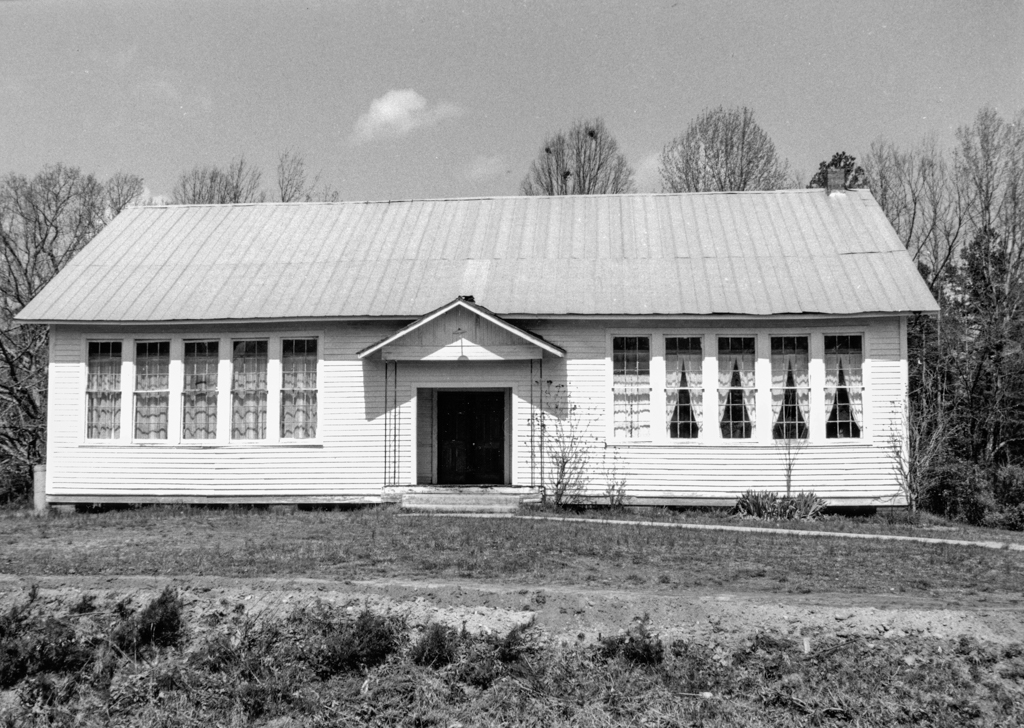
In 1912, Julius Rosenwald, president of Sears, Roebuck and Company, working with Booker T. Washington, established a fund to improve the education of African Americans in the rural South by offering matching grants for school constructions. Initially, the plans for these schools were designed by professors at Washington's Tuskegee Institute in Alabama. When liquidated in 1948, the Rosenwald Fund had partially paid for 351 rural schools in Virginia and a total of more than 5,000 schools in fifteen Southern states. The Salem School was financed with $2,600 dollars from public funds, $1,000 from gifts from blacks—primarily from the congregation of the Salem Baptist Church across the road— and $900 from the Rosenwald Fund. Like many rural schools of the era, the four-room, one-story frame building with a gable roof was for grades 1–7. The central recessed entrance, sheltered by a small pedimented roof, is flanked by a bank of five windows on each side. In addition to the entrance vestibule and side cloakroom, there are three classrooms and a cafeteria. The two rear classrooms originally had folding doors that could be opened to make one large assembly space. Following school desegregation in 1959 in Charlotte County, the school closed and is now used as a community center.
Salem School
1924. Cargills Creek Rd. at Tobacco Creek Rd.