

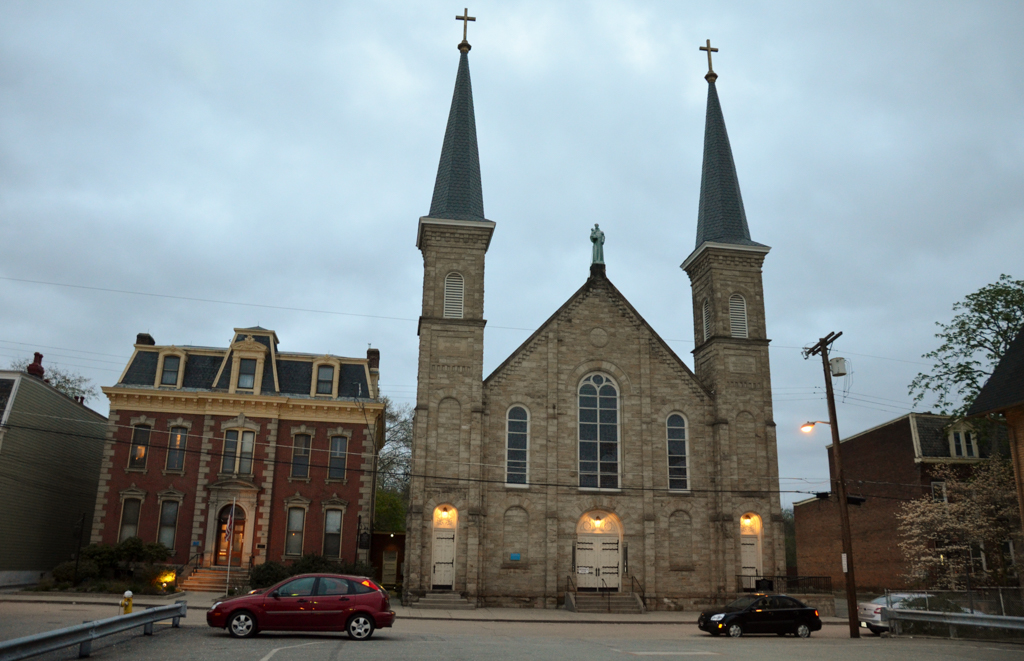
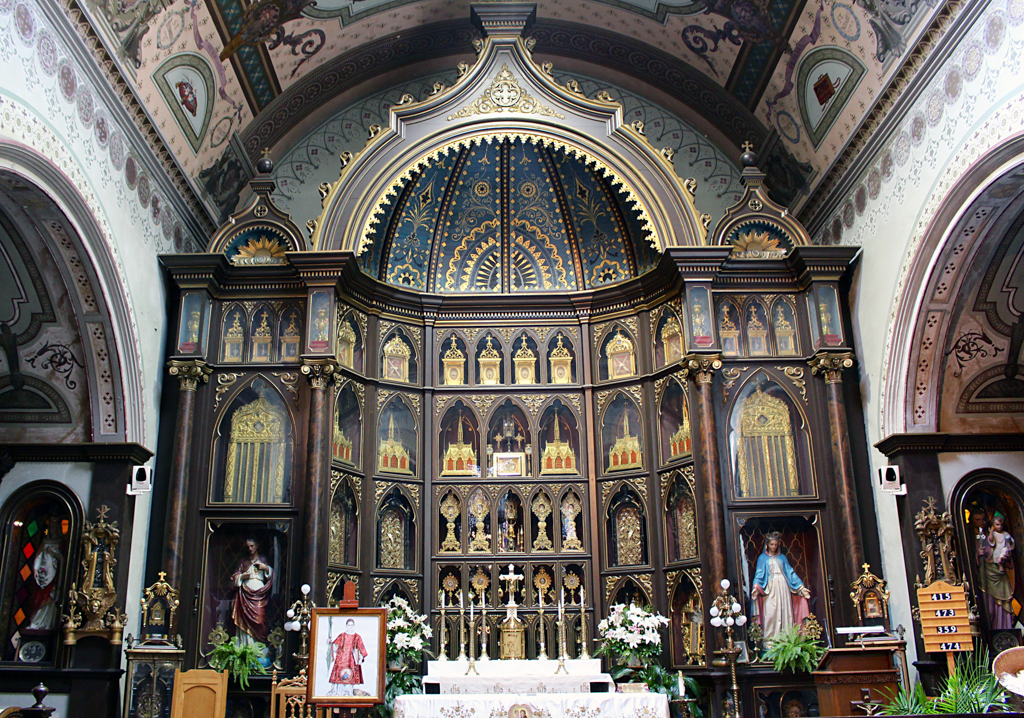
In the late 1870s, Suibertus G. Mollinger, the Belgian-born pastor of Most Holy Name of Jesus Church in Troy Hill, faced a unique problem: he had to house the thousands of relics that he and his agents in Europe had acquired. In 1880, Mollinger used his personal inheritance to build St. Anthony's Chapel, a small domed cruciform structure. It attracted such throngs of pilgrims that it was enlarged in 1890 to its present size.
The chapel's brick and sandstone walls and twin square towers are a German version of the Romanesque Revival popular earlier in the century. Both the roof and octagonal spires are of slate-covered timber. The church fits comfortably in the neighborhood; it is attractive, solid, and substantial, if not spectacular. In contrast, the interior is flamboyant in
After World War II, the numbers of pilgrims declined, and by the 1970s, the shrine had fallen into disrepair. Restored and refurbished in 1977, the shrine attracts a swelling number of visitors, with a catalogue of the relics now on a computer database.