

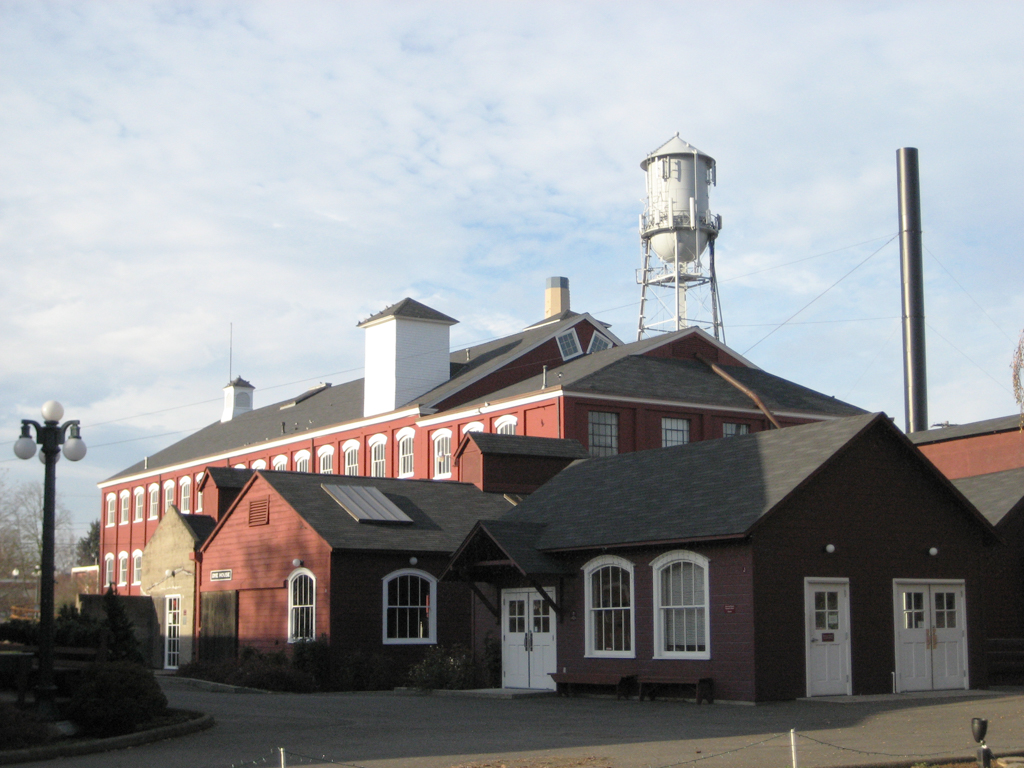
By the end of the nineteenth century, there were scores of water-powered mills in Oregon’s Willamette Valley. They were used for numerous purposes: for sawing timber, for grinding grain and flour, and for numerous textile mills. The Thomas Kay Woolen Mill outside Salem remains the only water-powered textile factory in the state, powered by an extended mill race diverted from Mill Creek.
The owner and builder of the textile mill, Thomas Lister Kay, was born in England in 1837 and immigrated to the United States in 1857; by 1863 he had settled in Brownsville, where he worked in the Brownsville Woolen Mill. He rose through the ranks to become superintendent and part owner by 1875. In 1889, Kay established the Thomas Kay Woolen Mill in Salem, where there was a labor supply more plentiful than in the small community of Brownsville. The original wood-frame mill building burned in 1895, though reconstruction began almost immediately on the same basalt block foundations, although now with thick upper walls of brick.
Designed by architect Walter D. Pugh and built by contractors John Gray and Henry Lukers, the new mill measured roughly 58 feet wide and 150 feet in length. The narrow but long layout followed the pattern developed in British textile mills, which included abundant side windows for bringing light to the factory floor, and overhead shafts, pulleys, and leather belts for the linear transmission of motive power across the factory’s length. Because of the weight and constant vibration of the textile machines, the structure rests on 3-foot-thick basement stone walls, with 17-inch-thick upper bricks, and huge wood floor beams measuring 12 by 16 inches. The original wood roof trusses and full-length floor timbers are also still in place.
The Kay Mill became a model for later, similarly arranged textile mills in Oregon. A sprinkler system, installed about 1900, is believed to be one of the earliest such systems in the state. The mill building complex eventually filled a large portion of south central Salem, with expansions in 1898, 1904, and 1925 that added several ancillary buildings, such as the dye house, a fulling house (where wool was cleaned), and offices. The work force originally numbered about 50 employees. The mill produced fine woolen blankets and fabric for more than 70 years and was managed by four generations of the Kay family.
Booming just after the turn of the twentieth century, the mill weathered the Great Depression, and then prospered again during World War II. Unable to compete with synthetic fabrics that entered the market after the war, the aging plant closed in 1959. In 1965 ownership passed to the Mission Mill Museum Association, a private, non-profit organization formed in 1964. In the late 1960s, several small, wood-frame buildings in the Salem area were relocated to the Mill grounds to protect them from demolition. These include the Jason Lee House (1841), the Methodist Mission Parsonage (1841), the John D. Boon House (1847), and the Pleasant Grove Presbyterian Church (1858). Today the area is collectively known as the Willamette Heritage Center, with the buildings open to the public for tours. Though the mill run still flows through Salem and through the Thomas Kay Woolen Mill before emptying into the Willamette River, a piece of wood passing through the turbine in 2007 permanently jammed the transmission gears. Electric motors now power the few original carding machines, spinning machines, and looms still used to demonstrate how the woolen mill operated.