

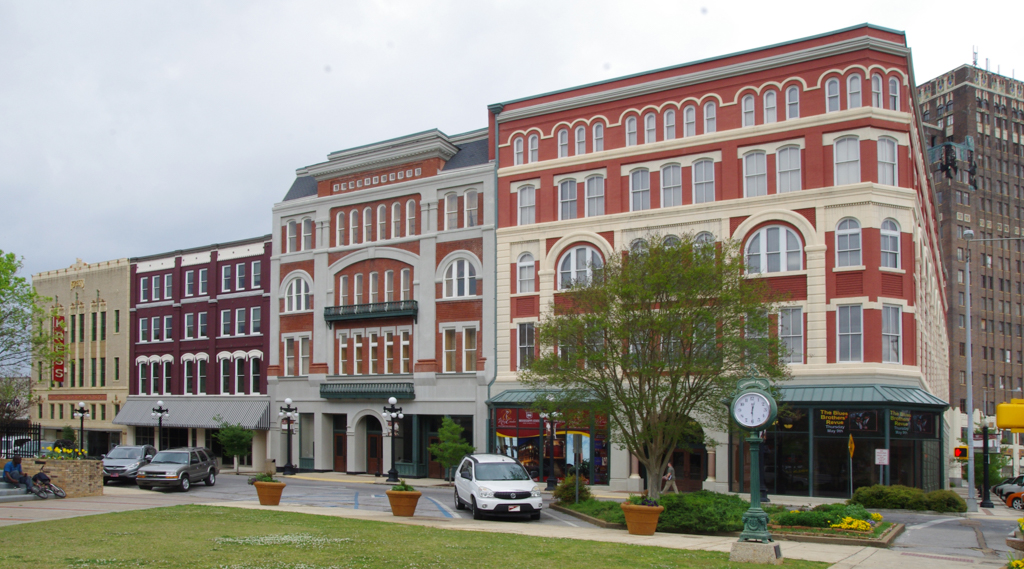
This is arguably the most impressive locale in the city, as it includes Meridian's Grand Opera House, which opened in 1890, and the adjacent Marks, Rothenberg store, the two now combined as the Mississippi State University (MSU) Riley Center. The original German-immigrant owners, half-brothers Israel Marks and Levi Rothenberg, commissioned local architect Torgerson to design the buildings and St. Louis theater designer McElfatrick to design the theater interiors. While the many-arched Romanesque Revival facades that Torgerson conceived for the side-by-side structures could hardly be described as elegant, the opera-house interiors are exceptional. The opera house originally had commercial space on its ground floor, with the front entrance leading to a grand staircase, which rose to the performance space on the second floor. The theater has always accommodated an audience of almost one thousand on a main level and balcony. Seating was segregated, with black attendees seated in the second, or highest, balcony. When black performers appeared, expanded balcony seating was provided for blacks attendees. Some of the theater’s early polychromatic color scheme, cherry wood wainscoting, seats upholstered in wine-colored velvet, and historic wallpapers survived, making possible an accurate restoration. On opening night in 1889, Marks and Rothenberg presented two German-language operas, and more operas, melodramas, and vaudeville shows followed over the next three decades. The house was adapted for films in 1920 but could not compete with new theaters and closed in 1927, remaining so until it was renovated and reopened in 2006, with the Marks, Rothenberg store converted into a conference center. A native of Sweden, Torgerson (1840-1902) came to America as supervising architect for the World Cotton Exposition in New Orleans in 1884 and also worked in Oxford, where he is buried. Local contractor Charles Rubush (1844-1912) built both the opera house and store.
Mississippi State University Riley Center for Education and Performing Arts
1889-1890, Gustave M. Torgerson and John B. McElfatrick; 1902, 1920 opera house renovated; 2006 opera house rehabilitated, Martinez and Johnson; store rehabilitated, Pryor and Morrow. 2200 5th St.