

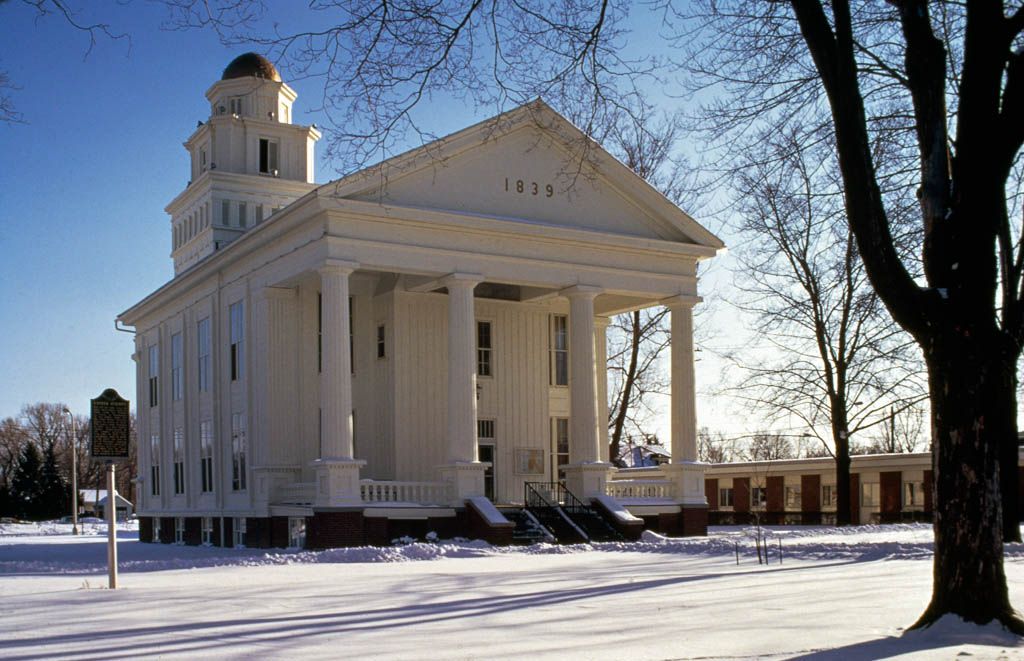
The Lapeer County Courthouse tells of the rivalry between the two families who settled Lapeer, those of Alvin N. Hart and Jonathan R. White. The twin settlements of Hart and White were designated as the seat of Lapeer County government in 1835. The first board of supervisors met in the winter of 1835–1836 but gave no indication as to which town would actually be the seat of government. So White completed a modest frame structure in 1840 and it was accepted by the board of supervisors on July 4 of that year. Apparently this small building was chosen over an equally modest one begun earlier by Hart. Undaunted, Hart began construction of a new, larger, and much more elaborate courthouse that was completed before 1846. The board purchased it from Hart in 1853 for $4,500.
This is the present two-story Greek Revival Lapeer County Historical Society Museum. It rests on a raised foundation and has a giant pedimented portico supported by four colossal fluted Doric columns. A three-tier square tower that contains the entrance and staircase and diminishes to a polygonal tier then a dome rises at the rear. The building is constructed of native pine on a brick foundation and sheathed with boards and battens. Horizontal boards laid with flush joints cover the exterior walls of the tower, and quoins in imitation of stone define its corners. Divided circular staircases in the tower lead to the second-floor courtroom. The heavily molded wood door and window enframements, wainscoting, and floors of the second-floor courtroom and other interior spaces are intact, but not as elaborate as the outside facades. The Lapeer County Courthouse remains a fine provincial example of Greek Revival.