

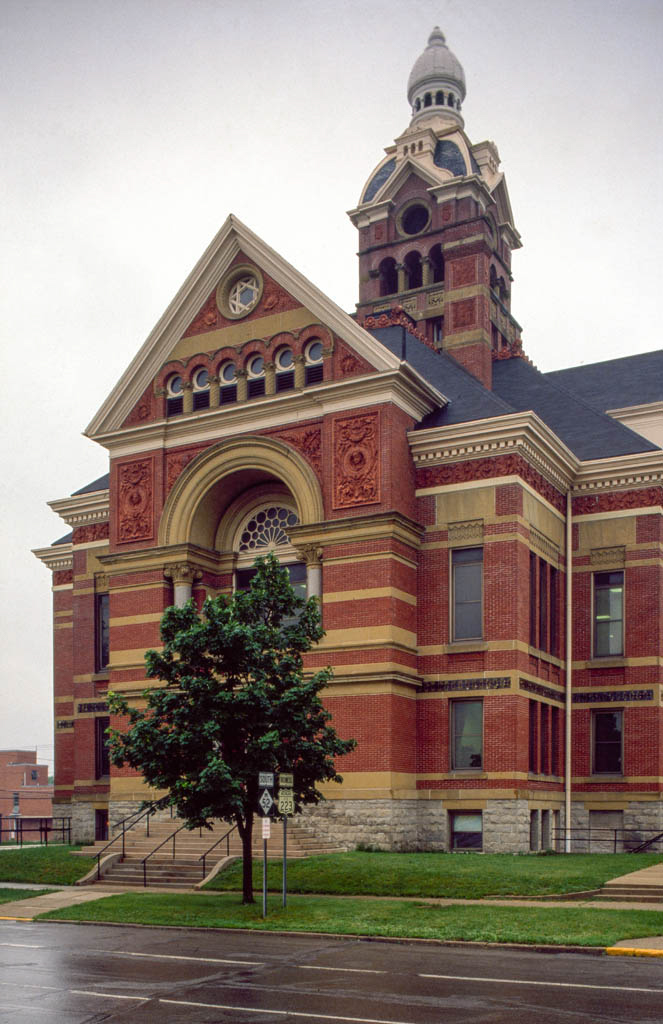
After the old county courthouse burned in 1852, the county government operated out of temporary quarters. Edward O. Fallis of Toledo, Ohio, prepared plans for the Romanesque Revival building located at the edge of the downtown business district. Fallis had apprenticed and worked with Charles C. Miller in Toledo, traveled to Spain and Italy, and enjoyed a reputation as a specialist in courthouse design. A heavy central tower with baroque details over the crossing of the roof dominates this building in a manner similar to European Romanesque churches. Gable-roofed pavilions project from all four sides of the large, hipped-roof courthouse built of orange-red Zanesville, Ohio, brick; light yellowish-tan Stoney Point sandstone (Lower Marshall sandstone) quarried southwest of Hanover; and Monclova sandstone from a bed near Toledo. The pedimented and arched entrance pavilion has a large fanlight on the second floor. The building is richly encrusted with red terra-cotta fascia and panels, some of which are sculptural reliefs of Law, Liberty, Justice, the Goddess of Agriculture, and celebrated local Shawnee chief Tecumseh. There are also brick corbeling, blue and green tile work, and polished granite columns. The interior is finished with carved Georgia yellow pine, mosaic floors, and lively ironwork. Allen and Van Tassel of Ionia constructed the building. As outstate Michigan's most opulent nineteenth-century courthouse, the Lenawee County Courthouse speaks of the prosperity of this southern agricultural county.
Lenawee County Courthouse
1884–1886, E. O. Fallis and Company; 1973–present restoration. 309 N. Main St.