

The Reverend John Codman, the first pastor of the Second Church (600 Washington Street, NRD), gave his name to the geographical
DR13
), the new congregation erected this church in 1805–1806. Designed in the Federal style that was typical of small towns in New England, the church remains a remarkable survivor in a neighborhood transformed by commercial development. Major additions to the rear of the church were made in 1892 and 1929.
The geographical importance of Codman Square continued after Boston annexed the town of Dorchester in 1869. Adjacent to the church stands the former Dorchester High School (370 Talbot Avenue, NRD), an 1899 design by Hartwell, Richardson and Driver with a 1910 addition by the same firm. Later known as the Girls Latin School, then Boston Latin Academy, the building has been converted into Latin Academy Apartments. The exterior remains one of the best examples of Renaissance design by this prominent Boston firm.
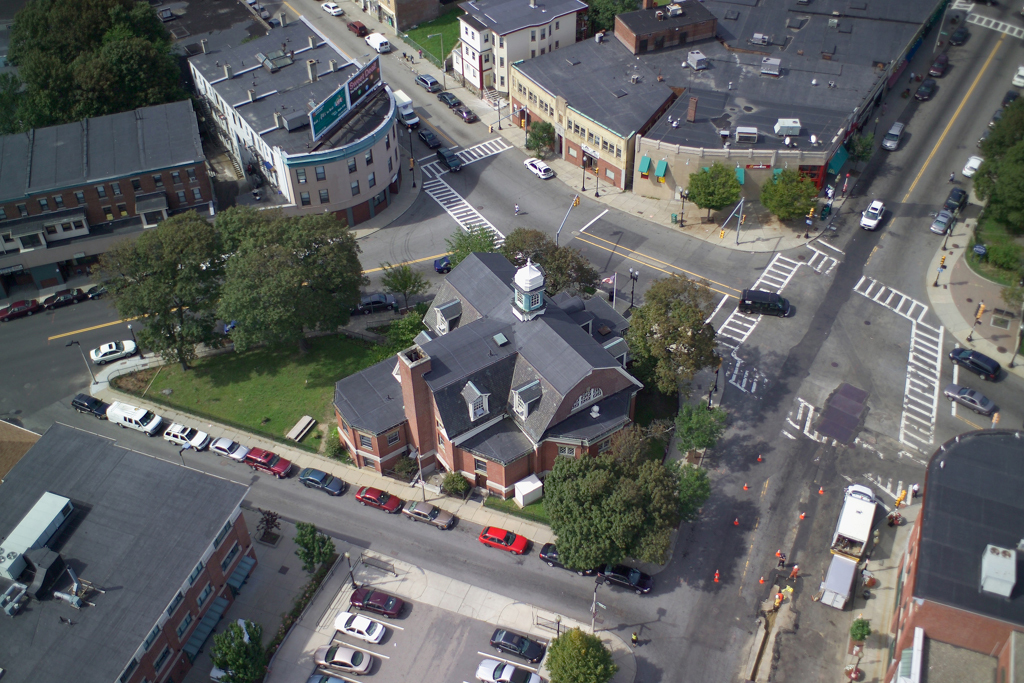
In 1904, City Architect Charles Bateman designed the Codman Square Branch of the Boston Public Library (6 Norfolk Street, NRD), now a community health center, a boldly articulated example of Georgian Revival architecture. The gambrel roof, cupola, and Palladian dormer make the former library a major Codman Square landmark. The Dorchester Temple Baptist Church (670 Washington Street, NR) is a beautifully restored Shingle Style design by Arthur H. Vinal that apparently was begun in 1889 and not completed until 1892. The broad front gable shelters three low ground-level arches counterpointed by the square tower to the right that flairs out for the open belfry topped by a pyramidal roof.