

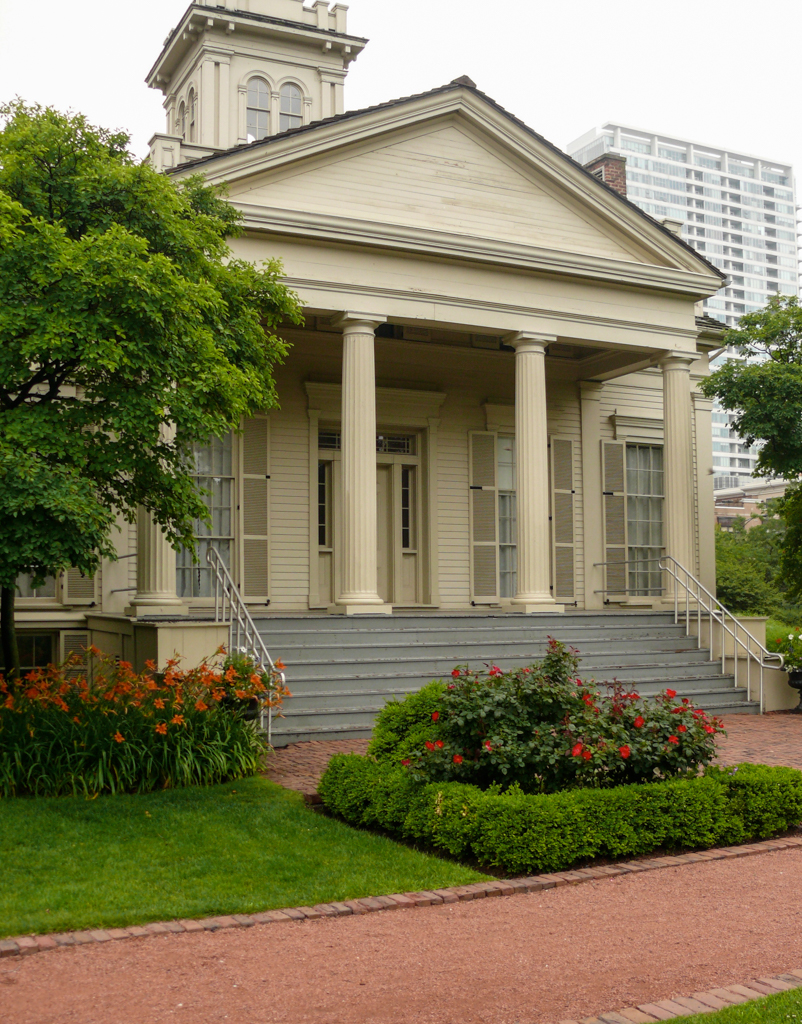
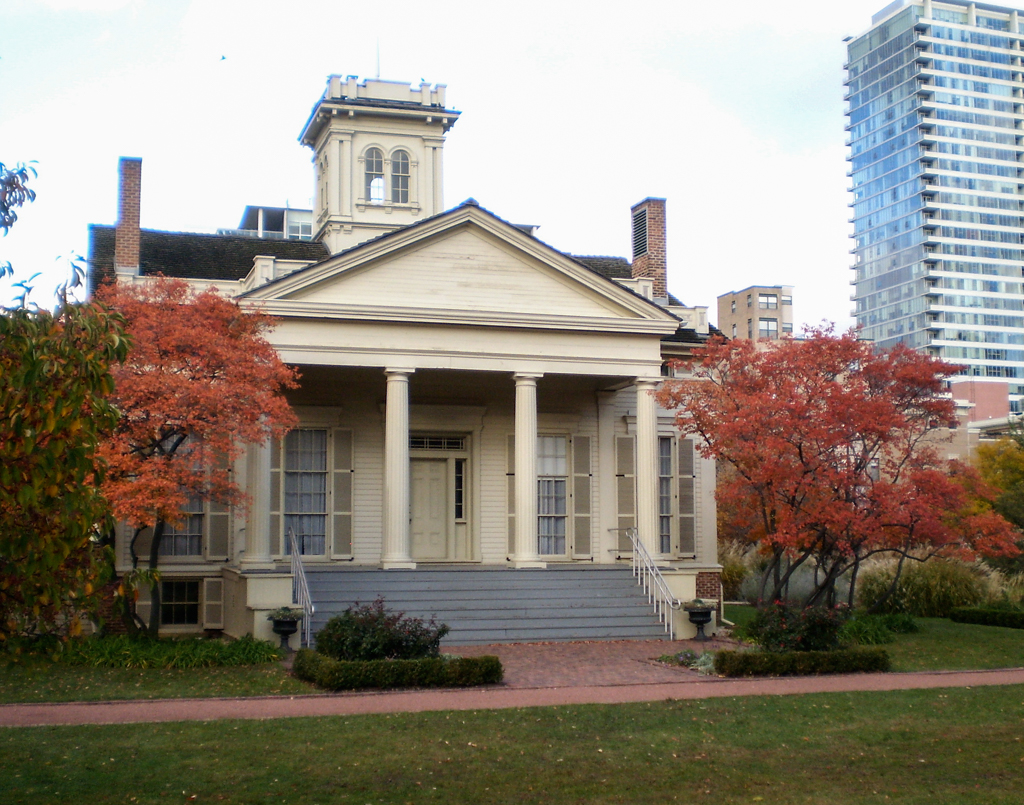
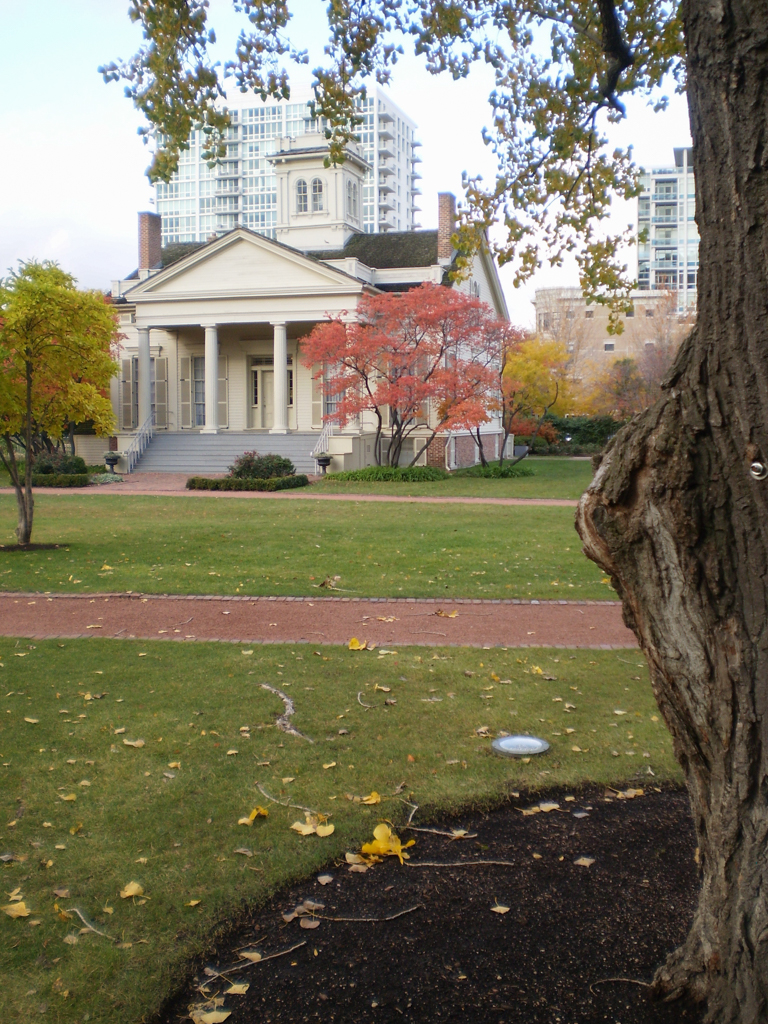
This frame building is the oldest surviving structure in Chicago and the city’s only intact example of the Greek Revival. The house was originally located along Lake Michigan at Sixteenth Street and Michigan Avenue. It was built for a hardware merchant, Henry Brown Clarke, who had recently moved to Chicago from Upstate New York, where the Greek Revival was popular. Clarke commissioned his builder to erect a large house in that style, using squared logs with mortise-and-tenon joints and covering the exterior with horizontal wood clapboards. The design reportedly was modeled on a residence (no longer extant) for Chicago Mayor Odgen, which had been designed by John Mills Van Osdel, the city’s first architect.
The house is raised a half-story above grade and features corner pilasters and ornamental cornices above the tall doors and windows. The main elevation (facing Indiana Avenue) is dominated by a large portico supported by tall Roman Doric columns and featuring a triangular pediment. A smaller square porch is on the rear facade. A low ornamental railing defines the edge of the roof, which is crowned by an Italianate-style cupola addition dating to the 1850s. The tall front doorway, which includes a transom and sidelights, leads to a wide central hall featuring a walnut-railed staircase. Two large parlors flank the hallway on the main floor; while the second floor contains six bedrooms bisected by a narrow hallway.
In the 1850s, following Clarke’s death, his widow, Caroline, remodeled the house, including the addition of a rooftop cupola. Following the 1871 Chicago Fire, the house was moved by a subsequent owner to 4526 South Wabash Avenue, where it later was occupied by St. Paul Church of God and Christ. After a serious fire in 1977, the house was purchased by the City of Chicago, which moved it to city-owned property at 1855 South Indiana Avenue, roughly three blocks from its original location. The building was thoroughly renovated at that time: modern mechanical systems were installed and the floors and staircase were reinforced with steel. A more recent restoration project brought back the house’s original colors and finishes. The Chicago Department of Cultural Affairs and Special Events operates the house as a museum.