

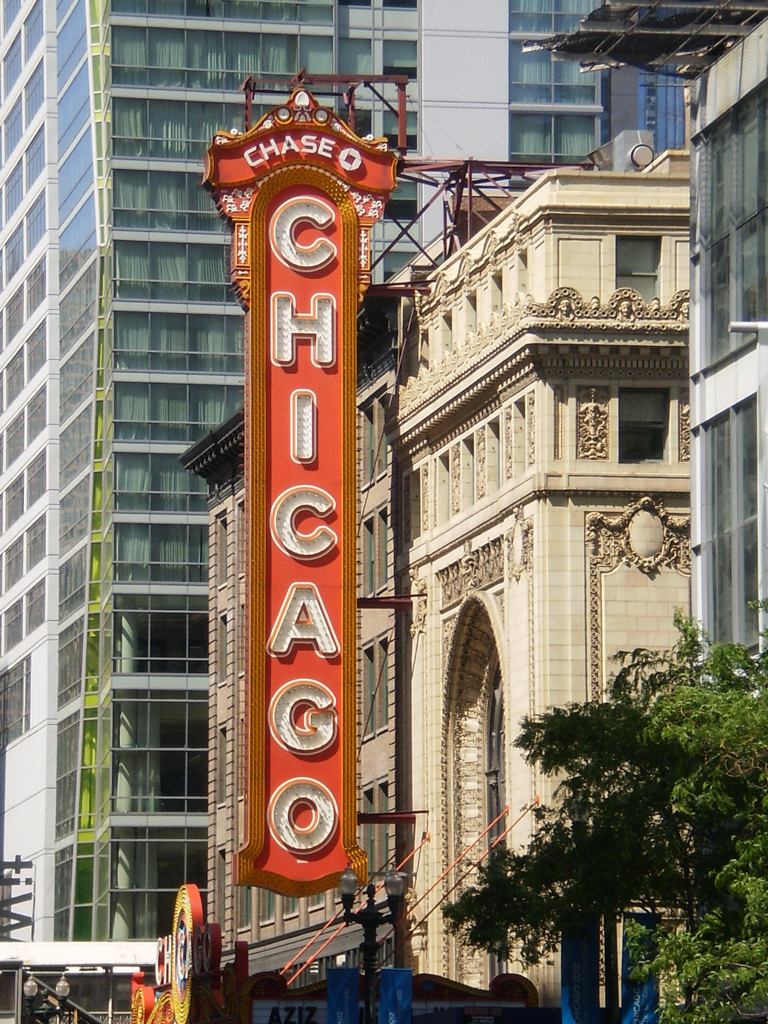
Chicago was an epicenter of grand movie palaces in the 1920s and the Chicago Theatre (originally known as the Balaban and Katz Chicago Theatre) was the first of its kind (and the oldest surviving example) built downtown by the prolific architecture firm of Rapp and Rapp. Brothers Cornelius W. Rapp and George Leslie Rapp built their first movie theater in Chicago in 1917. They specialized almost exclusively in entertainment venues for the next 25 years.
At the Chicago Theatre, the State Street elevation is relatively narrow and entirely sheathed in highly decorative terra-cotta. An enormous round-arched window rises like a triumphal arch above the iconic red marquee and is surmounted by two attics with an ornate cornice between them. The window contains the whimsical Balaban and Katz coat of arms. Tall flat panels on either side of this window are outlined in Rococo ornament. An enormous neon sign projects from the north end of the facade, emblazoned with a single word, “CHICAGO.” The Rapps employed an army of plaster workers to cover nearly every available surface in the lobby and auditorium. Extensive coloration and strategic lighting were part of the magic as well. A wildly eclectic composition, the Chicago Theatre contains elements that can be characterized as Neo-Baroque French Revival.
With the Chicago Theatre, Rapp and Rapp established a successful formula for the downtown movie palace, one they would employ repeatedly in over 400 theaters nationwide. A large lobby (or multiple lobbies) enabled theater owners to quickly turn over audiences between performances. Typically the lobbies were multi-storied with grand staircases and promenades. Enormous auditoriums and deep balconies with uninterrupted views gave every ticket holder a good seat. Opulent and exotic decorative schemes combined with luxurious amenities, such as marble bathrooms and early cooling systems, gave patrons an extravagant experience. In many of their theaters, Rapp and Rapp increased the owner’s revenue opportunities by joining the theater to an office building (for example, Chicago’s Cadillac Palace Theatre, 1926) or a mixed-use office, retail, and residential building (such as Denver’s Paramount Theatre, 1930).
Although much of the original decoration in the Chicago Theatre is gone, the State Street facade and the impressive interior spaces continue to make the building a vital part of Chicago’s Theatre District.