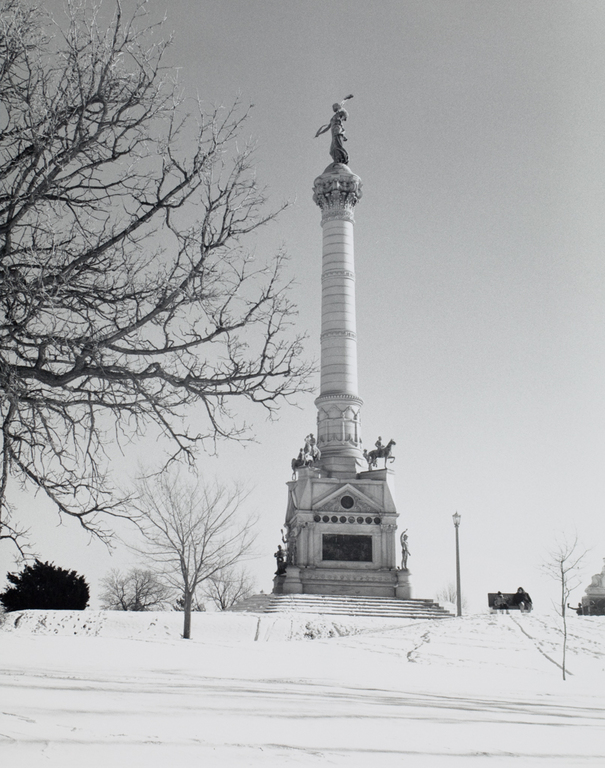
A special state commission was appointed in 1888 to supervise a competition for a monument to honor Iowans who fought in the Civil War. Forty-eight submissions were received the following year, and from these the commission selected the design of Harriet A. Ketcham of Mount Pleasant, Iowa.
17 Her initial design was an equestrian figure placed upon an elaborately decorated sarcophagus. The sarcophagus was in turn set on a four-step podium; within one of the niches of the sarcophagus was a seated female figure (symbolizing the state of Iowa), and standing on two of the corners were the figures of a soldier and a sailor. After winning the competition Ketcham revised her design by replacing her equestrian figure with a column surmounted by a wingless figure of Victory. Ketcham died before the state legislature appropriated funds for the monument in 1892. In 1894 the Danish-born sculptor Carl Rohl-Smith was commissioned to construct the piece based on Ketcham's revised design. Work started in September of 1894, and it was basically finished in 1897. As built, the sarcophagus came close to looking like a small classical temple; two additional figures joined the soldier and sailor at the base, the figure of Iowa became a partially nude maiden holding her breasts, and she was matched on the other side by a seated figure of an old woman (History) accompanied by a standing young child. At the four upper corners of the sarcophagus are equestrian figures. Functioning as a sort of entablature around the sarcophagus are rows of commemorative cast-bronze medallions. The figures are also cast in bronze; the rest of the monument, including its Corinthian column and capital, is in granite.
Notes