

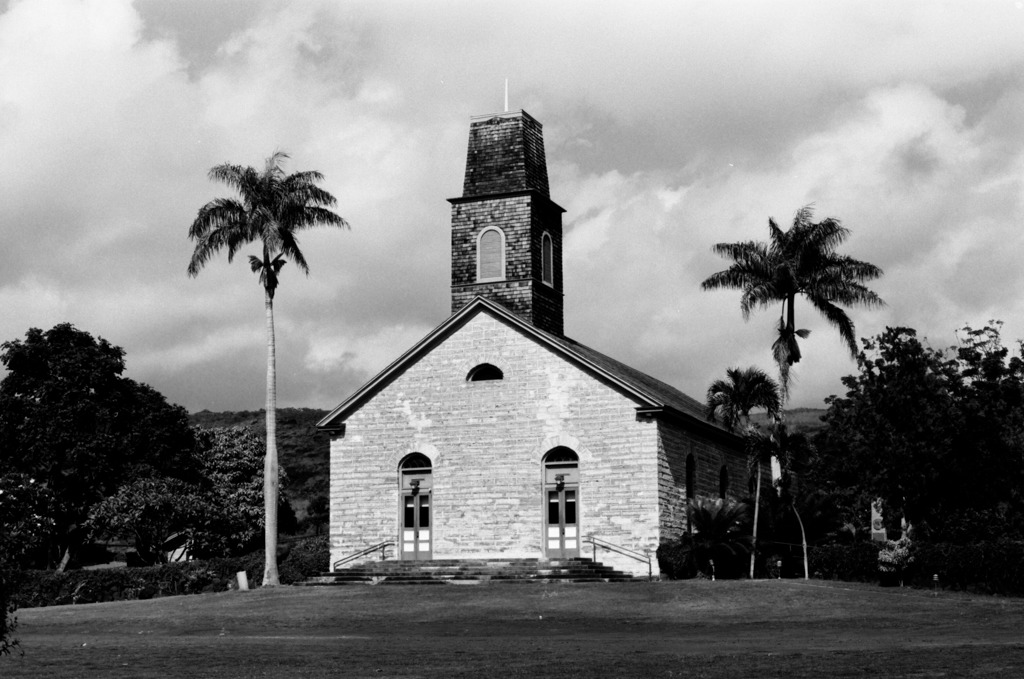
An imposing edifice, sited on a knoll above Waimea town, the “Great Stone Church” is surrounded by an expansive lawn and encircling stone wall. A major project, this building was constructed of local sandstone and designed by missionary Rowell. Its simple rectangular plan is capped by a gable roof with returns, surmounted by a truncated steeple. Rowell and his wife, Malvina, arrived in Hawaii in 1842, part of the tenth company of missionaries. Initially assigned to Waioli, this devout couple was reassigned to Waimea in 1846 following the death of the Reverend Samuel Whitney. Rowell repaired and expanded the stone house erected previously by the Gulicks (KA1), and then commenced construction of this church, which opened in 1854. Rowell presided over it until 1865, when he was suspended from the Hawaiian Evangelical Association on account of his suspect theological positions and reports that he had had illicit relations with a Hawaiian woman. A number of Hawaiians stood by Rowell, and the pastor and his congregation tried to hold control over the stone church. However, the Hawaii Supreme Court ruled against them and, in 1867, Rowell and his followers formed the Waimea Hawaiian Church, building a Victorian frame church at the corner of Kaumualii Highway and Halepule Road. Rowell continued as its pastor until his death in 1884. In 1992 Hurricane Iniki collapsed this charming building; the congregation rebuilt it along the lines of the original.
Following Rowell's discharge, the Great Stone Church's congregation greatly declined, and between 1873 and 1889 it had no regular minister. It became the Waimea Foreign Church in 1894. The church was remodeled around 1920, with the belfry being rebuilt and the openings given shallow Gothic arches. Hurricane Iniki decimated the roof and, in turn, the interior, leading to its restoration in 1993 under the direction of Spencer-Mason Architects.