

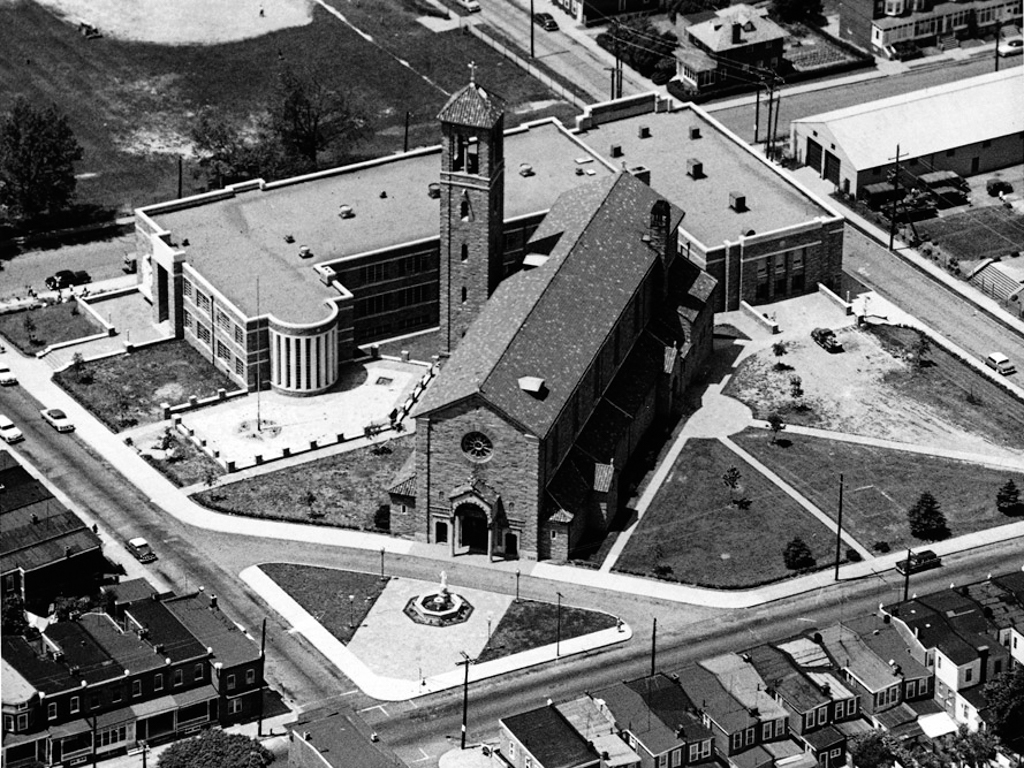
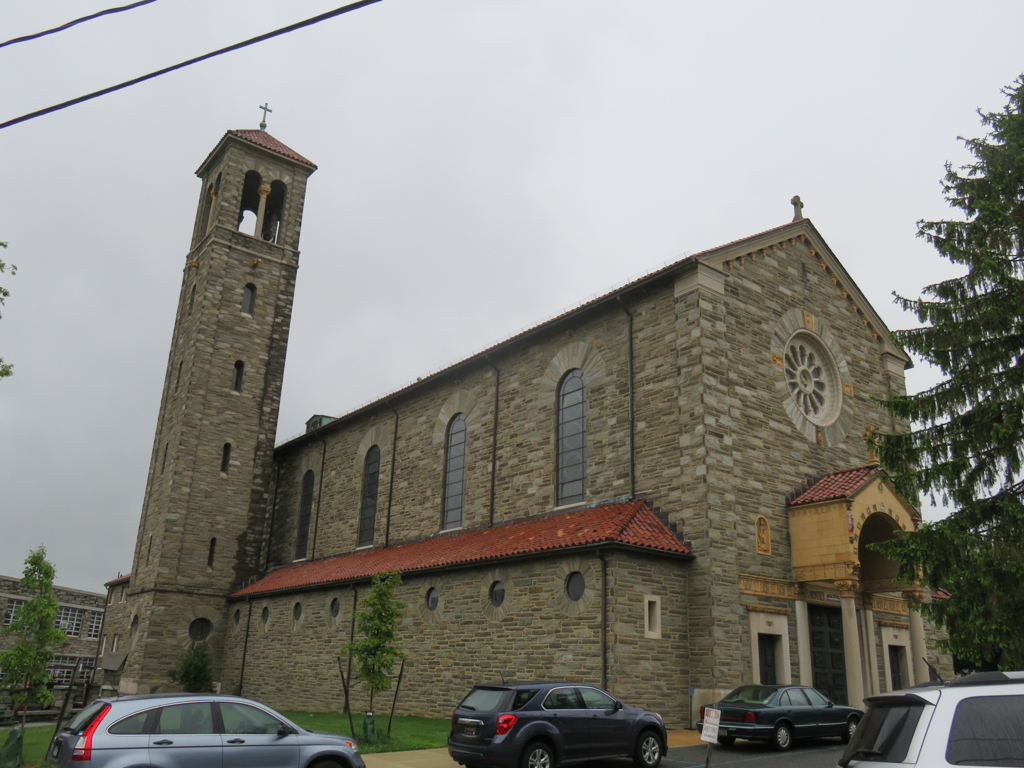
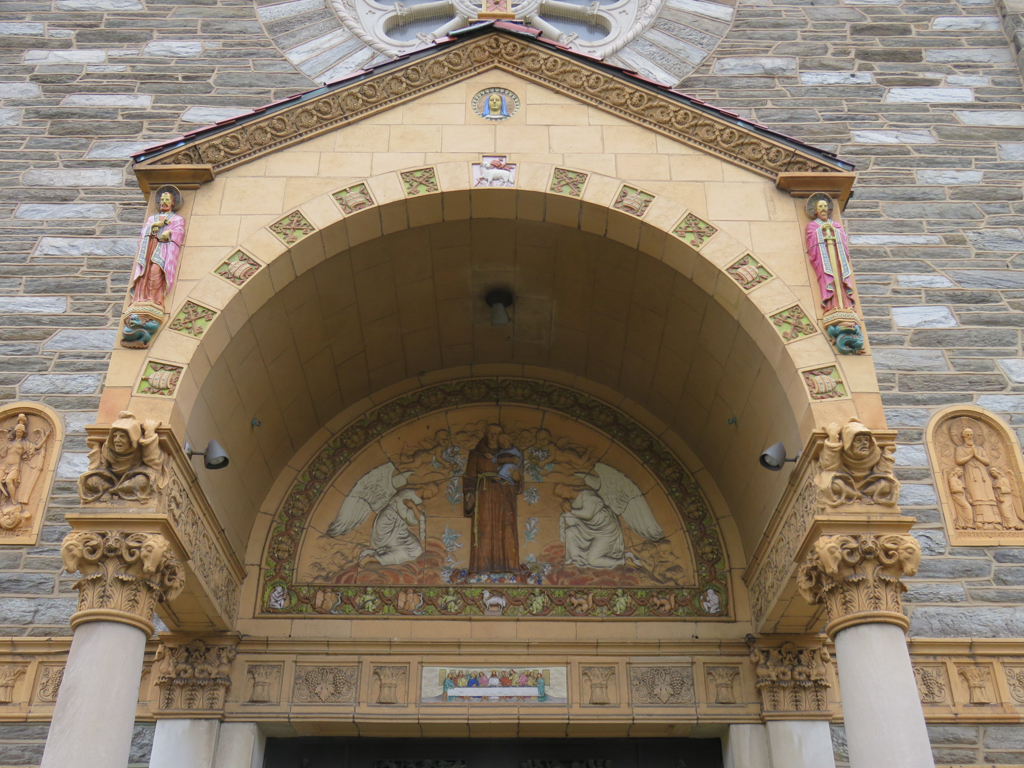
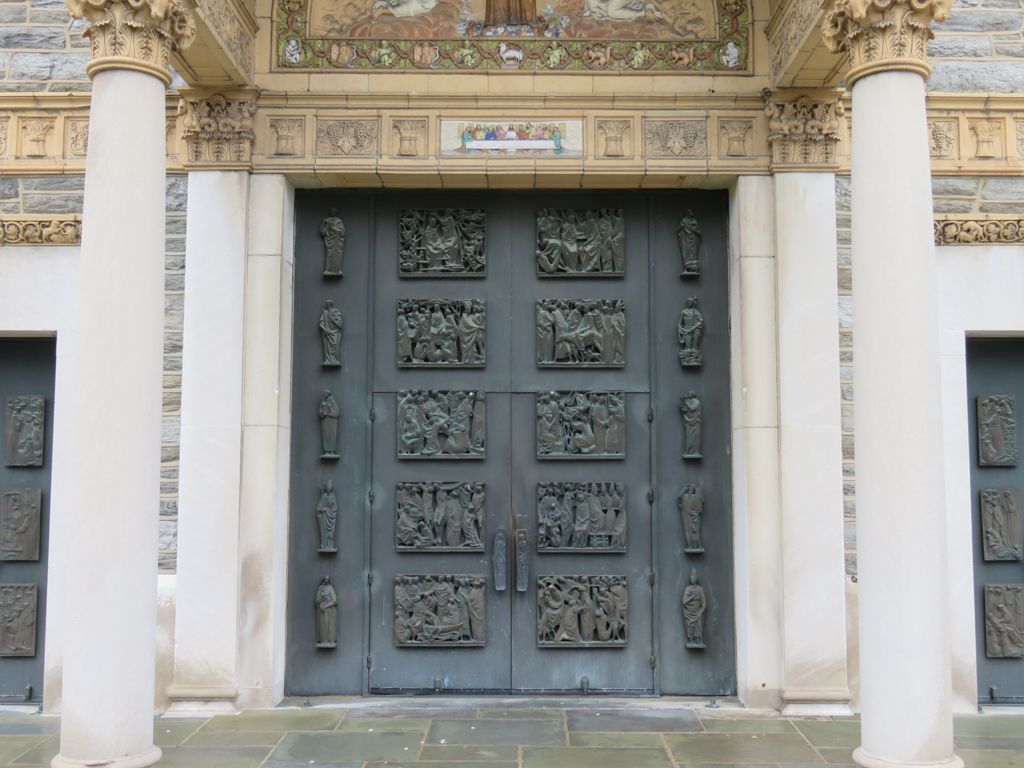
For generations, the church's tall campanile has soared above Little Italy, cherished symbol in a state in which almost one person in ten claims Italian ancestry. Architect Thomas F. Mulrooney, a native Wilmingtonian with his office in Philadelphia, traveled to Italy with the congregation's Father Francis Tucker to study churches. The Italian Romanesque–style edifice the firm designed was usable by 1926, but full completion took decades; the 125-foot campanile (with radio-electric chimes) was erected only in fall 1937 and the ceiling given its barrel vault in 1948. Outer walls are gray Wissahickon schist from Pennsylvania. Based on the church of St. Zeno Maggiore, Verona (1123–1135 AD), the entrance porch is of orange terra-cotta on limestone columns. Polychrome sculpture hints at the spectacle that awaits one inside: a huge, echoing nave; a wide ceiling enriched with colorful coffers; ten bronze coronas hung from long chains; arcades supported by columns of scagliola (over structural steel) with richly modeled capitals depicting rams' heads and peacocks. The mosaic over the sanctuary arch consists of several million tesserae, fabricated at the mosaic studio of the Vatican and shipped in sections in 1949, the year the Siena marble altar was added. A Philadelphia artist, Paula Himmelsbach Balano, designed the stained glass. The aisles are dense with candle-lit shrines, statuary, and more scagliola, examples of nearly forgotten arts. One enters the memorable church through bronze doors (1966) by local architect Leon N. Fagnani and Italian sculptor Egidio Giaroli.
St. Anthony of Padua Church
1925-1948, Gleeson, Mulrooney and Burke. 1952-1953 school, Gleeson and Mulrooney. 1960-1961 rectory, Leon Fagnani. 901 N. Du Pont St.