

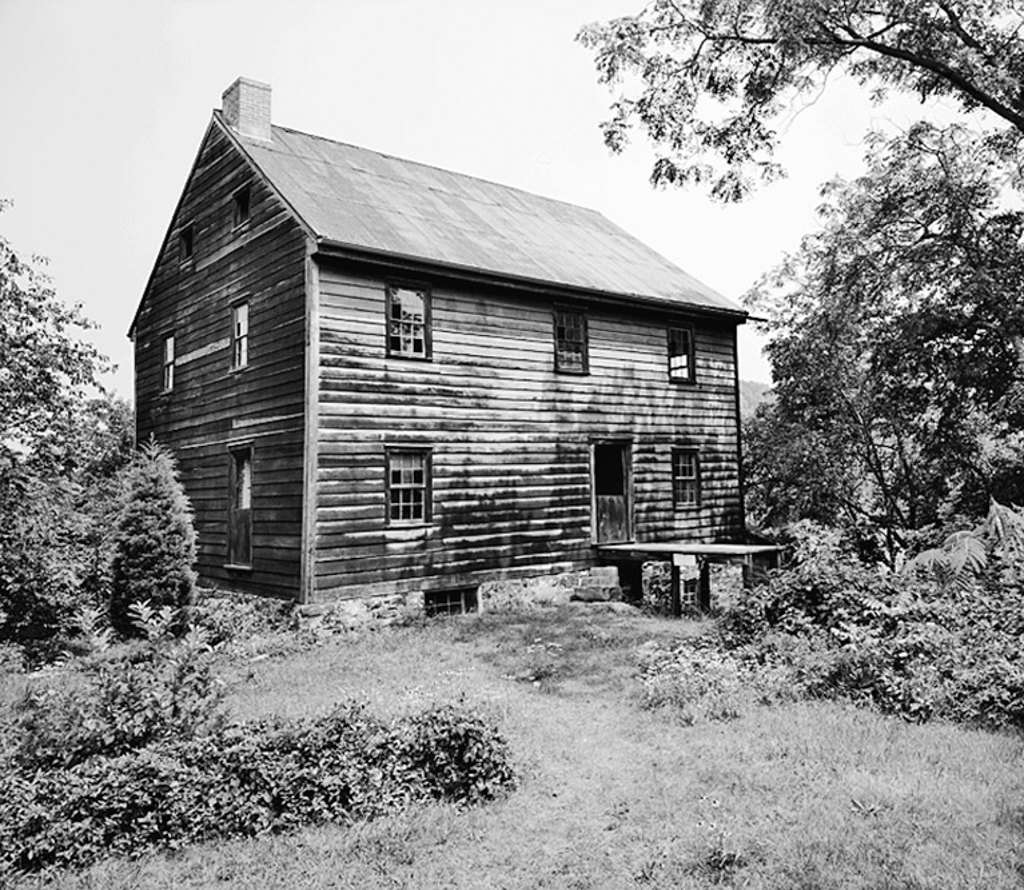
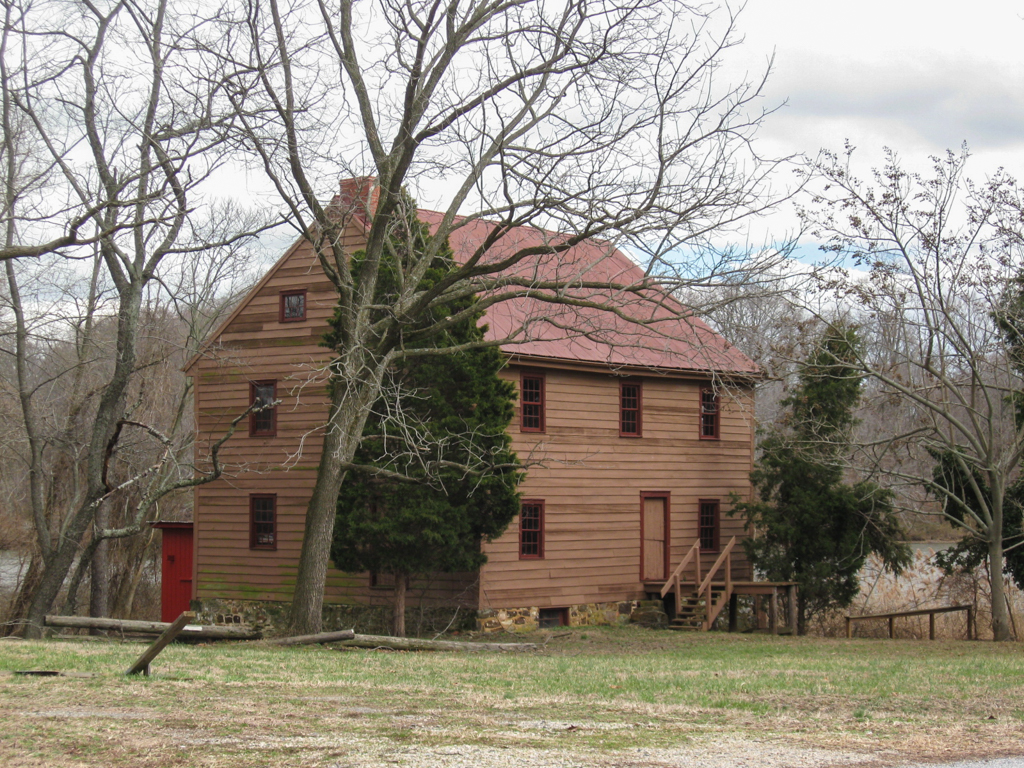
Here is a rare survival, a frame industrial structure from the eighteenth century, analogous to Maryland's famous Wye Mill on the Eastern Shore. Thomas Noxon, born in Kingston, New York, in 1669, owned several mills in Delaware. He settled here on the Appoquinimink in 1735 and built the brick house that still survives (1740 datestone). Noxon lived to see his mill seat expand into a little town, chartered in 1742, a year before he died. An annual fair became popular, and the patriot Colonel John Haslet wrote to Caesar Rodney in 1776 worrying that “the People [would] attend Noxontown fair rather than the Election, and sell their Birthright for a piece of Gingerbread.” By the time adjacent St. Andrew's School (LN19) was founded, the mill was seasonally busy pressing apples for cider and grinding corn, and it found a new function in providing wheat for bread in the dining hall. The structural fabric of the now-idle building is well preserved, though its bakehouse, brewhouse, and malthouse are gone, and the machinery has been changed over the years. Architectural historian Bernard Herman has studied the framework (1987): “In this small-scale industrial structure, the principals carry the major elements of the wall framing [as well as] a timber girder that spans the length of the building and which is supported at mid-point by a decorated chamfered edge post and pillow.”
Noxontown Mill
c. 1740. Noxontown Rd. at Appoquinimink River, southeast of Middletown