

At the extreme southeastern corner of Delaware stands an old stone that has marked, since 1751, the start of the Transpeninsular Line, the state's southern boundary. Quarried and carved of oolitic limestone in England, it still shows the arms of Lord Baltimore (of Maryland) and William Penn (of Pennsylvania). The U.S. Lighthouse Board, established in 1852, reported to Congress three years later that a light was needed here to guide vessels from southern ports and Europe to the mouth of the Delaware River and to warn them of the “very dangerous” Fenwick Island Shoal. The resulting eighty-four-foot cylindrical brick lighthouse contained a third-order Fresnel lens manufactured in France. A ventilator ball stood atop the lantern assembly. The light burned whale oil for the first twenty years, then mineral oil, before conversion to electricity in 1899. It was automated in 1940 and, after twelve decades of continuous use, shut down in 1978. Popular with tourists, the lighthouse is the last to survive directly on the Atlantic coast of either Maryland or Delaware.
Fenwick Island Light Station
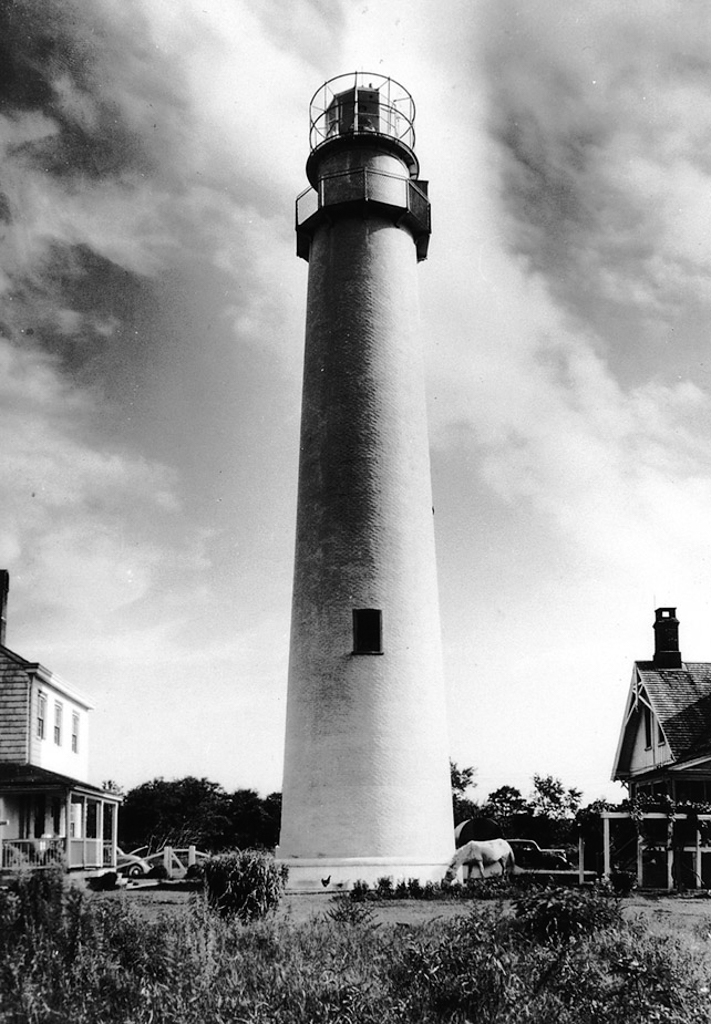 Delaware Postcard Collection, University of Delaware Library, Newark, Del
Fenwick Island Light Station
1858–1859 lighthouse. 1857–1858 and 1882 keepers' houses. Near corner of Lighthouse Rd. and DE 1, Fenwick Island