

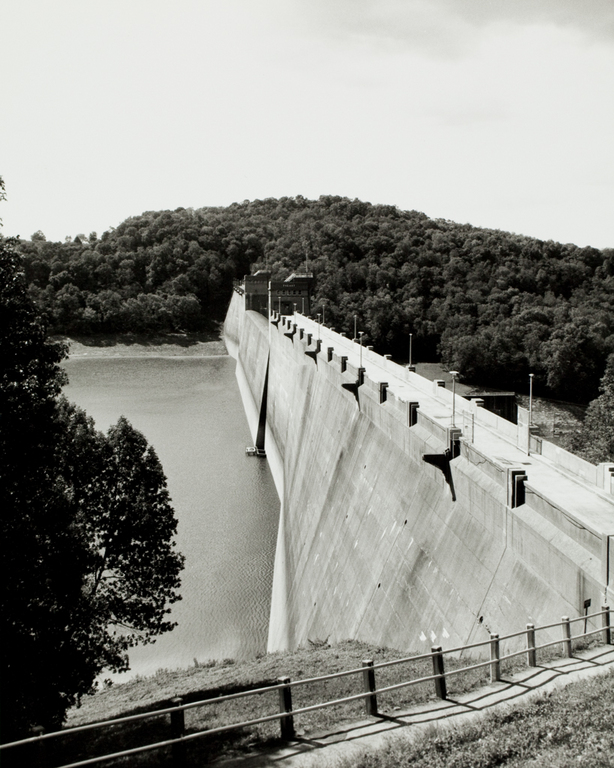
The Public Works Administration (PWA) sponsored this straight-crested, concrete gravity dam to control floods in the upper Ohio River basin. Tygart Valley River, which the dam impounds, is a tributary of the Monongahela, which joins the Allegheny at Pittsburgh to form the Ohio. The dam stretches 1,921 feet and rises more than 200 feet above the streambed, making it the highest concrete gravity dam east of the Mississippi when it was completed. Its designers conducted hydraulic experiments, including building scale models, to perfect the spillway layout. Wellons was principal engineer of the Pittsburgh District, U.S. Army Corps of Engineers. Cret, French born and Beaux-Arts trained, and one of the country's preeminent early-twentieth-century architects, is best known for his modern interpretations of classical forms, evidenced in his Folger Shakespeare Library and Federal Reserve Board Building, both in Washington, D.C. Horace Peaslee, of Washington, served as a consultant for the landscaping and for houses built for the dam tenders.
The U.S. Army Corps of Engineers maintains the dam, and West Virginia has established Tygart Lake State Park on the extensive shoreline. Because the dam is so significant in the history of federal flood control of the nation's rivers, it has been declared a National Historic Landmark.