

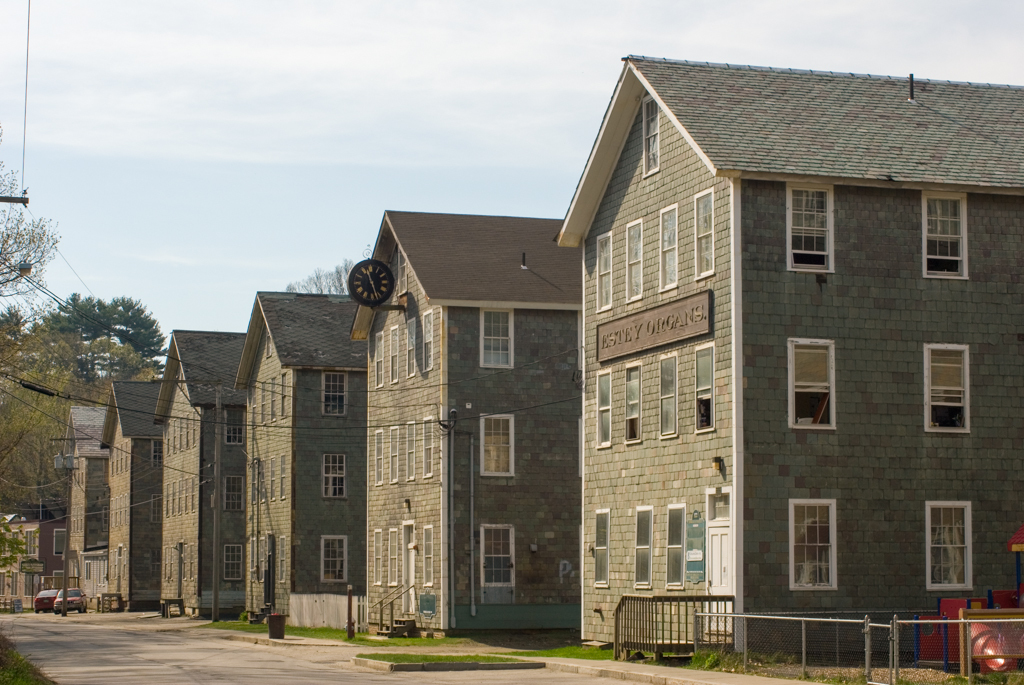
High above Brattleboro village, a row of seven nearly identical industrial buildings stands as a reminder that the town was once a world center for organ manufacturing. In 1852 pump and pipe manufacturer Jacob Estey obtained a share in a melodeon business at a moment when there was growing demand for the reed parlor organ as a compact and economic alternative to the piano. Estey bought out his partners and, after fires and a flood destroyed several early works, relocated the plant here and founded the district known as Esteyville. He aligned six nearly identical three-story, gable-front mill buildings overlooking the town in 1870 and 1871, and in 1872–1873 added two additional, matching structures. In 1906, these last two were joined as one and raised an additional story. All seven buildings are sheathed in slate shingles for fire protection, an unusual application of a durable local material that is more generally used for roofing. Original six-over-six sash windows remain in several of the structures, and the building at 24 Birge Street retains a fanlit entrance. The firm's carved signboard and clock also survive. After decades of unsuccessful diversification, Brattleboro's most famous and important industry closed in 1958. In recent years, multiple owners have worked to preserve the striking industrial complex for mixed storage, office, retail, and residential use.
Estey Organ Company
1870–1873; 1906 addition. Birge St., just south of Estey St., City of Brattleboro