

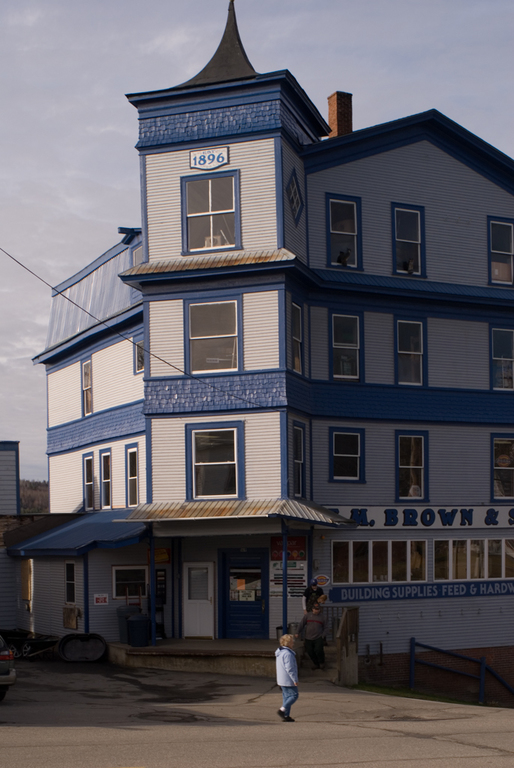
This building illustrates the activity that once made Barton village an industrial powerhouse in the county. The community grew along the outlet of Crystal Lake, where it dropped ninety feet in a sequence of falls to join the Barton River. Mills were built as early as 1796, but it was the 1858 arrival of the Connecticut and Passumpsic Rivers Railroad and connections to Boston, New York, and Quebec that spurred industrial development. The falls' power was harnessed to process local lumber and imported cotton and iron for export as chair parts, window sashes, blinds, doors, carriage wheels, toilet seats, piano actions, bowling pins, plows, stoves, machinery, and underwear.
At a prime location in the midst of this activity and across from the depot, the Tower brothers built their three-and-a-half-story gambrel-roofed gristmill. Its angled corners feature an entrance tower with bellcast roof to the southeast and a second-story oriel to the northeast. Queen Anne shingled bands and a pent roof organize the facades, tying together roof, oriel, and tower. Inside were a corn cracker, a corn and oats blender, a grinder, and a bucket elevator to carry grain to five-thousand-bushel-capacity storage bins. The mill survived as its industrial neighbors failed and burned. Grain was ground until World War II, and water powered the elevator until 1974. Though unused since then, the dam, turbine, and machinery that operated the mill remain largely intact, making this one of the better-preserved water-powered mills in Vermont.