

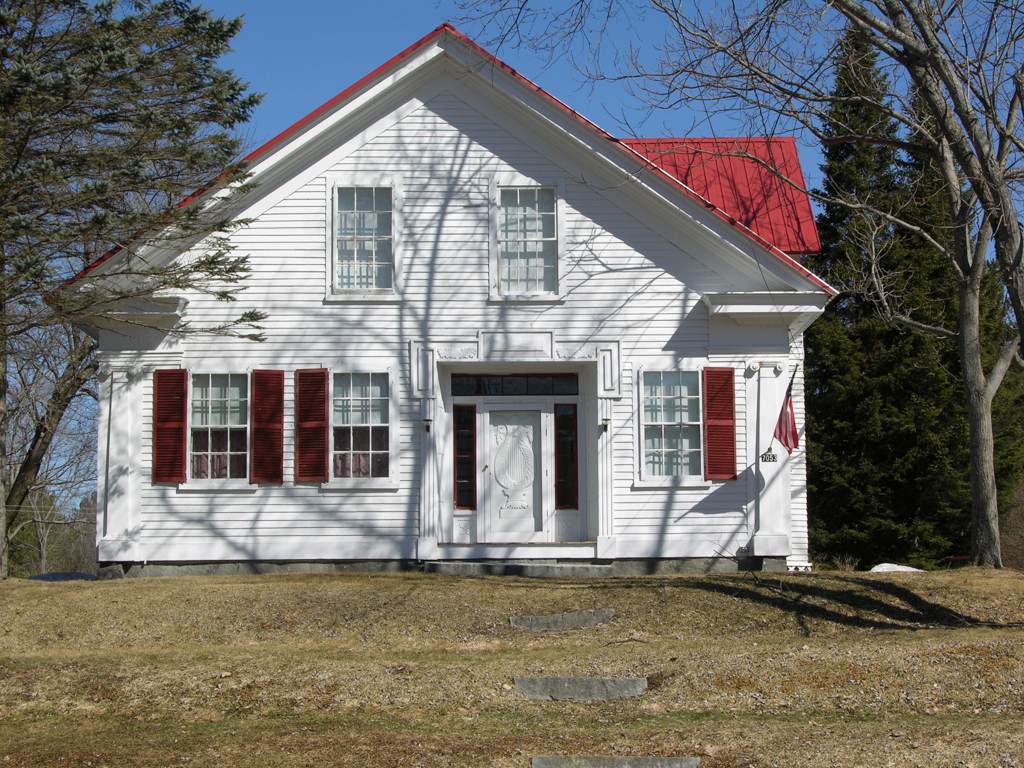
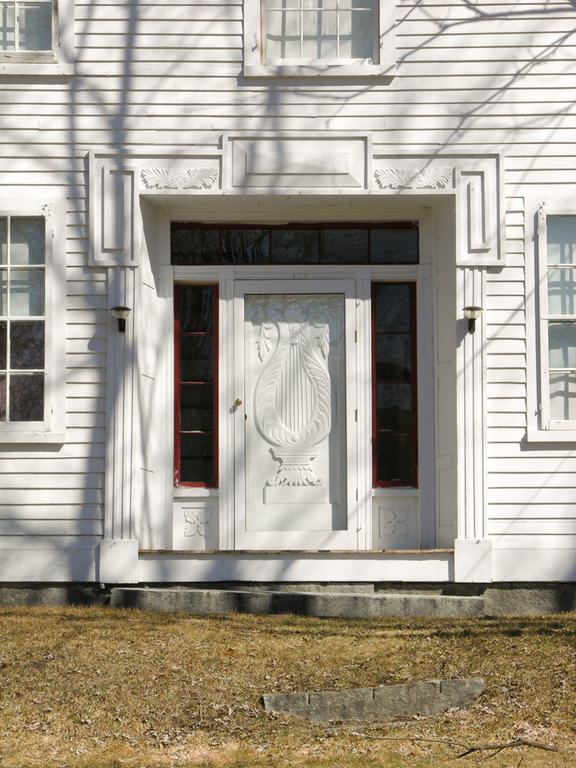
Once it achieved status as the Essex County seat in 1798, Guildhall village attracted professionals and a level of architectural sophistication absent in most other small villages along the far reaches of the upper Connecticut River. In 1808 Essex County state's attorney Seth Cushman acquired a small one-story, wood-frame dwelling built in 1807 with an attached stable, and maintained the building as his law office until 1829. In 1850 Dr. Henry L. Watson paid builders Asa Stewart and Asa Stewart Jr. two hundred and fifty dollars to construct a Greek Revival addition onto the law office for his residence; the office became the rear ell. The Stewarts delivered a vernacular masterpiece, largely due to the carving and finish carpentry skills of Stewart Jr. Not conforming to any traditional plan, the one-and-a-half-story wood-frame addition is nearly square in footprint and provides a right-of-center recessed main doorway on its gable front that opens directly into one large parlor. It is Stewart's inventive interpretation of Greek ornament that stands out, notably the entablature with cornice returns that wraps and is supported by Ionic corner pilasters with “roller skate” volutes. The pilasters are applied on a wide board in the manner of the Federal era. The recessed entrance with transom and wide sidelights focuses the eye on a single panel door with a four-foot-tall stylized carving of a Greek lyre, perhaps the finest carved Greek Revival door in Vermont. The entrance surround has a top-center raised panel, Greek key shoulders, fluted side boards, and oak leaf carvings on either side of the raised panel, which echo similarly styled carvings in panels beneath the sidelights.
Watson House
1807; 1850, Asa Stewart and Asa Stewart Jr., builders. VT 102, 0.2 miles west of Guildhall Common, Guildhall village