

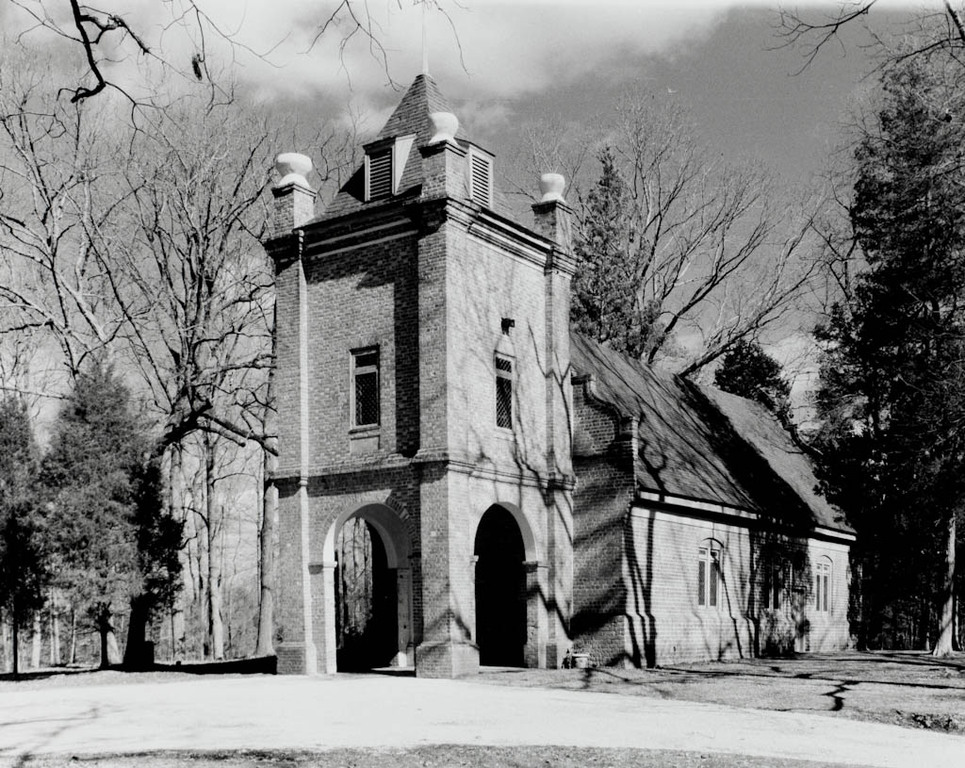
One of the most celebrated and interpreted churches in Virginia, St. Peter's has been described as late Gothic, transitional to the classical, Jacobean, and baroque. Isolated and rural, it gives a sense of the opulence Virginia's colonial elite strove to attain. It is remarkable, but much has been reconstructed and is conjectural. Disestablishment and use as a stable during the Civil War destroyed great portions of the fabric. The main body of the church was constructed in the early eighteenth century to replace an earlier church at a different location. Investigations during the 1940s and early 1950s revealed that the Flemish gables had been reconstructed, but whether they are original is conjectural. They are of oversized brick laid up in an English bond, with molded elements that are particularly fine. The tower was added about 1740. It incorporates an amazing variety of elements: molded brick, cornices, massive corner pilasters, recessed panels, windows, and stuccoed urns, one of which serves as a chimney. The pyramidal roof and the dormer windows are conjectural reconstructions, possibly dating from the 1870s, though an early drawing does suggest them. The tower housed a vestry room, and apparently a stairway once led across the north archway giving access, though it may have been an early nineteenth-century addition. Original access is unclear. The Jacobean-style woodwork in the vestry room is recent. The internal door off the gallery probably dates from 1872. All of the interior is reconstruction except for the wainscoting in the chancel, which may date from the 1730s. The casement windows, although replacements, are confirmed as accurate by a 1704 order for glass, lead, and casements. A plaque on the north wall with an indistinct inscription commemorates the Reverend David Morsom, rector for four decades, who married George Washington and Martha Custis. She was a member of the parish during her youth. The graveyard contains pre-Revolutionary tombs.
St. Peter's Church
 Virginia Division of Historic Resources
St. Peter's Church
1701–1703, William Hughes, carpenter; Cornelius Hall, mason. 1739–1741, William Walker. 1872, 1950–1951, renovations. 1964–1965, restoration, J. Ambler Johnston and Harden deVoe Pratt. VA 642 (VA 106 north from I-64, VA 609 north from Talleysville 1 mile, right on VA 642 for .4 mile), Talleysville vicinity