

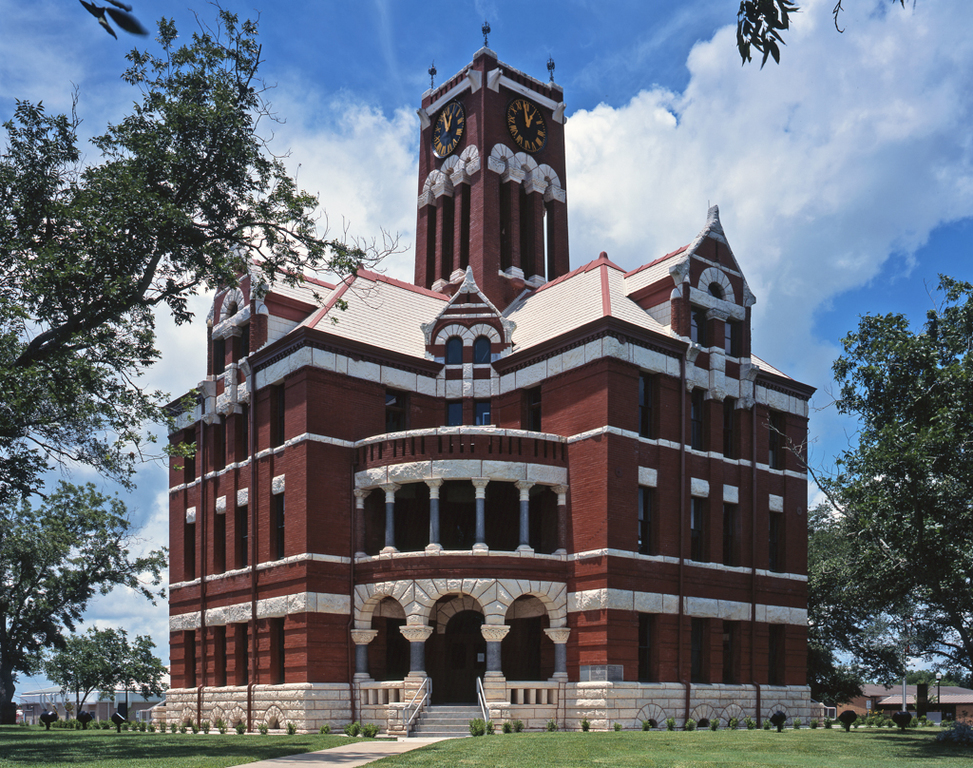
This Romanesque Revival building is the second courthouse constructed on the site. Gordon used his trademark curved corner entrances to bridge the arms of the cross-shaped plan. The Texas Cordova Crème limestone bands and arches strongly contrast with the deep red brick, a bolder use of color than in Gordon's Comal County Courthouse (1898), where he built the same design in limestone. The slight taper of the tower forces the perspective and makes it look taller. The restoration architects followed Gordon's furniture plan to relocate desks, chairs, and courtroom furniture to their original positions. Unique to Gordon's plan is the placement of the jury who faced the judge with their backs to the courtroom's spectators. During the restoration, a paint analysis revealed the original interior colors of yellow, gray, blue, and mauve under a layer of white paint added in 1911. Structural failure began within two years of the building's opening in 1899, necessitating the addition of two columns in the courtroom, and replacement of the slate roof with lighter metal shingles and the ceiling's plaster finish with tin. The courthouse was rehabilitated with funding through the Texas Historic Courthouse Preservation Program.
Lee County Courthouse
1897, J. Riely Gordon; 2004 restoration, Rabe + Partners. Bounded by W. Austin, S. Leon, E. Hempstead, and N. Grimes sts.