

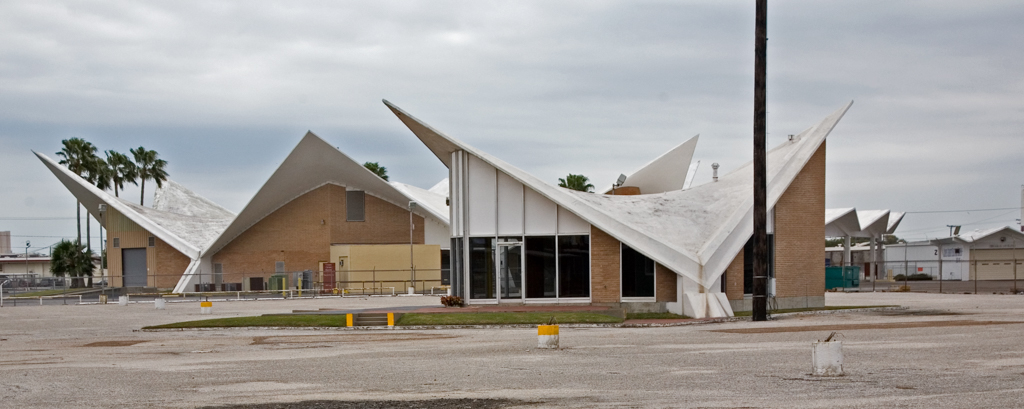
The complex recalls an unquestioned faith in modernity. During the 1960s, Corpus Christi was at the helm of the “Coastal Bend Revolution” with numerous examples of “hyperbolic paraboloid thin shell concrete warped surfaces,” in the technical terminology of the time.
The still-intact thirteen-acre complex comprises several cast-in-place structures, each with their own singular modular geometric design, which permitted the concrete shell to be a mere two inches thick. It was built by Braselton Construction Company, whose owner, Guy Braselton, matched engineer Wilkerson's avid enthusiasm for the slender volumetric shapes. Specifically, Wilkerson's interest stemmed from his 1950s tenure as architect and engineer in Richard S. Colley's office, where he was influenced by Félix Can dela's thin shell roof system design for Colley and O'Neil Ford's Texas Instruments Semiconductor Plant of 1958 in the Dallas area. Together, Braselton and Wilkerson collaborated on numerous occasions to build standout examples of thin shell construction reflecting “the influence of the Space Age [and] . . . loosening the bonds of tradition and convention,” as touted in a September 1963 cover article in Texas Architect praising this promising building technique.
Prominently sited at the intersection of two main thoroughfares, the circular former auto showroom links a set of eight hyperbolic paraboloids that dynamically thrust upward at each of their pointed ends. At the time, the showroom's 185-foot clear interior span was considered as the largest to be erected in concrete in the United States. No longer transparent due to the loss of its glazing, the showroom includes a detached, folded-plate service canopy to its rear that acts as a well-integrated appendage beneath the pointed forms. Nearby, facing Leopard Street, a single paraboloid, still with its original glazing, served as office space for the used car sales section of the dealership. In the center of the complex, two large service wings, each of diagonal folded-plate construction, housed the repair shops. The wing facing Port Avenue cleverly transitions a change in height to accommodate large trucks. To the rear, a freestanding canopy sheltered the gas pumps, while next to it an elegant flat-roofed pavilion functioned as the car wash.