

The oldest, and for a long time the longest, tunnel in the United States completed William Penn's idea of linking the Susquehanna and Delaware rivers. Unfortunately, soon after it was completed railroads would supplant canals for moving heavy materials. Dug through the ridge dividing the waters of Quittapahilla Creek and Clark's Run, the tunnel was originally 729 feet long. Its route was laid out in 1762 by Philadelphia scientist and mathematician David Rittenhouse assisted by the son of the College of Philadelphia's provost William Smith. First chartered as the Schuylkill and Susquehanna Canal Co., construction began in 1792 under the direction of William Weston, an English engineer. Several miles of the easy parts of the canal were dug and five locks were built between Myerstown and Lebanon before financial difficulties caused the work to cease. It was this area that President George Washington visited in 1793. Reorganized in 1811 as the Union Canal Company of Pennsylvania with Samuel Mifflin as president, work began again in 1821 under the direction of chief engineer Canvass White, of Erie Canal fame, with Simeon Guilford as his assistant. The canal was finally completed in 1828. A branch canal was finished in 1832 reaching from a pumping station at the village
Union Canal Tunnel
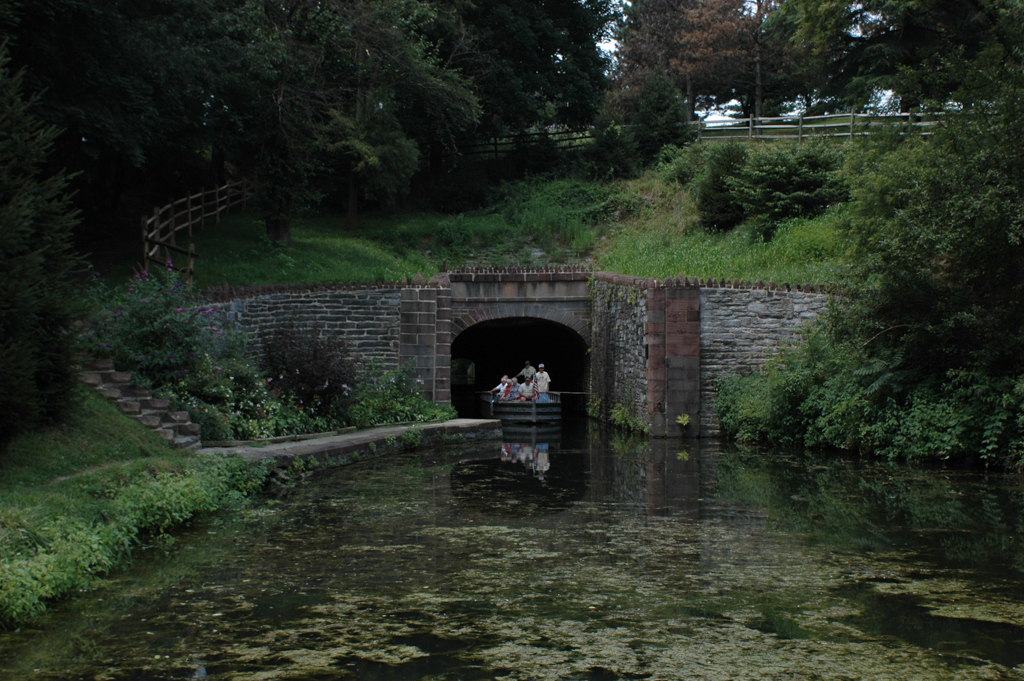 © George E. Thomas
Union Canal Tunnel
1825–1827, Simeon Guilford, engineer; John B. Ives, contractor; c. 1855. N. 25th St., off PA 72, West Lebanon