

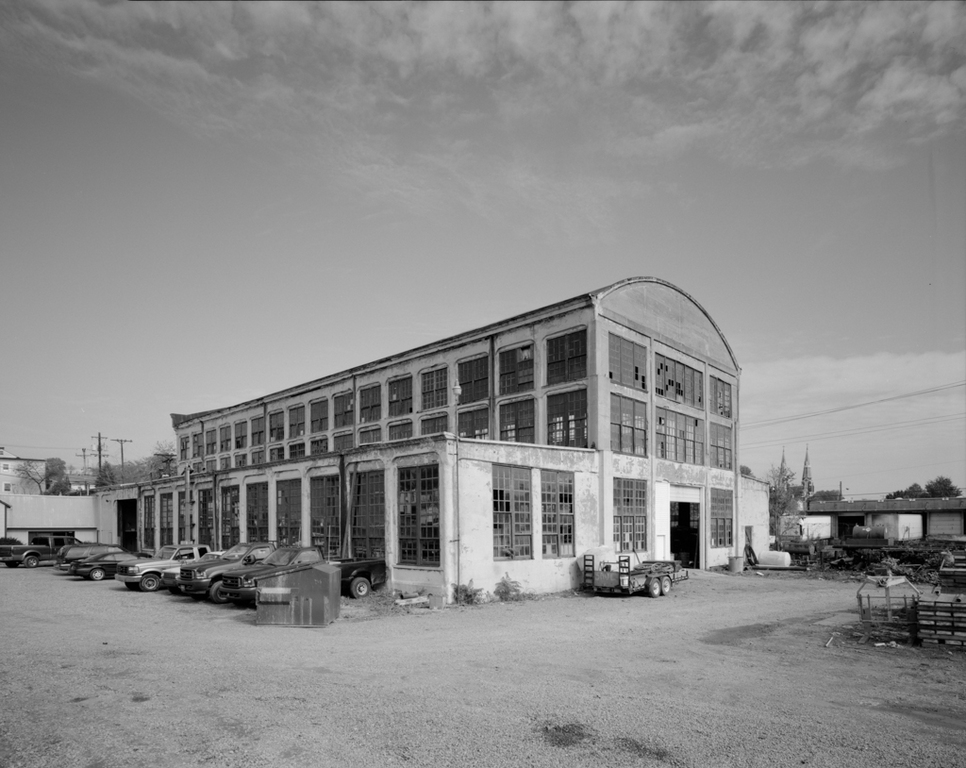
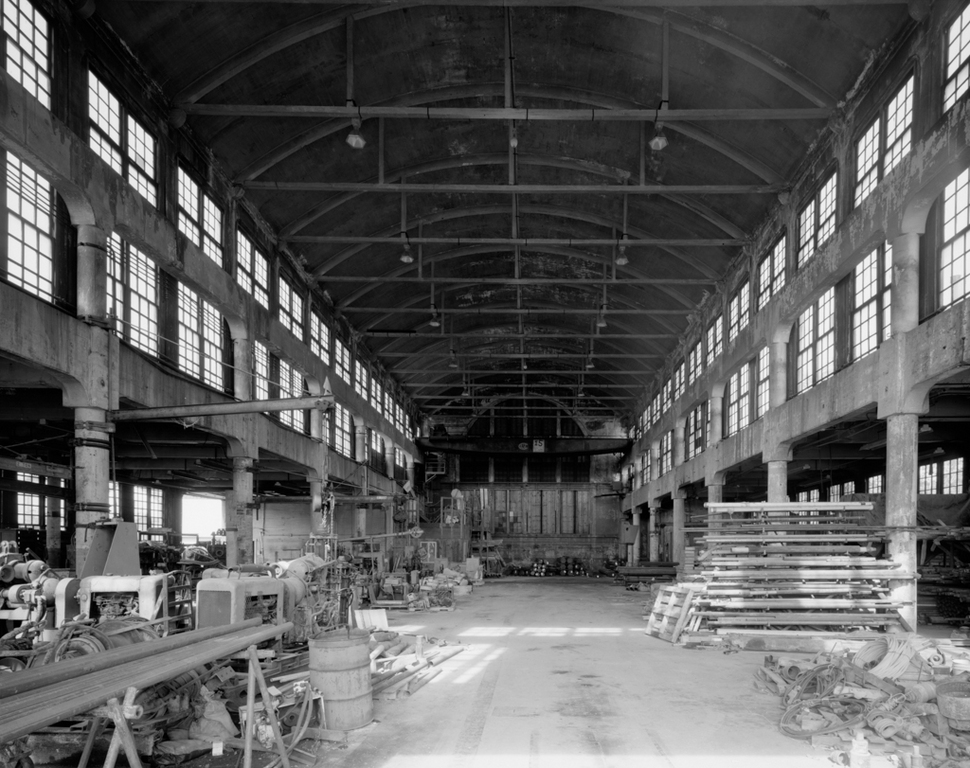
One of a handful of buildings remaining in a barren industrial strip, the former Taylor-Wilson factory is an overlooked marvel of the pioneer generation of “daylight factories” that revolutionized industrial design at the turn of the twentieth century. By 1884, engineer Ernest L. Ransome and others had perfected a system of reinforcing concrete with iron rods to increase its strength. This reduced the need for structural support, and allowed the number and size of windows in exterior walls to be increased significantly. Industrial buildings could now consist of more window than wall, and, flooded with natural light, they provided a more productive and humane environment for workers. Significantly, Ransome built his first daylight factory in 1902 in nearby Greensburg (altered; 1225 South Main Street, Westmoreland County), and Cummings doubtless visited it. For Taylor-Wilson, Robert Cummings followed Ransome's patented mode of construction, which allowed exterior columns to intersect with projecting floor slabs, hence countering structural forces through a framework rather than through solid masses of wall.
Cummings designed Taylor-Wilson to be cheap and fireproof, and also to show artistic flair. Six bays wide, sixteen bays long, and three stories high, it encloses an enormous space (160 × 120 feet) with a gently arched roof, one-story projecting aisles, and a facade dominated by a round-arched window twenty feet in height, though now boarded over.